0
0

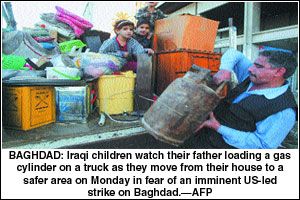 UNITED NATIONS, March 17: The United States and Britain abandoned diplomacy on Monday, telling President Saddam Hussein to leave Iraq or face certain war, as the United Nations ordered its staff to pull out of Baghdad.
“The time for diplomacy has passed,” Secretary of State Colin Powell said, previewing an address to the nation to be given by President George W. Bush.
The US president was to issue an ultimatum to Mr Saddam to go into exile — something the Iraqi leader has ruled out, vowing to die in his homeland, Mr Powell said, setting the stage for imminent strikes on Baghdad.
Mr Powell said Mr Saddam “has had his chance, he has had many chances over the last 12 years and he has blown every one of those chances,” while White House spokesman Ari Fleischer added: “The diplomatic window is now closed.”
UN Secretary General Kofi Annan ordered weapons inspectors and humanitarian staff to leave Iraq, lamenting the “human catastrophe” of an impending war.
Iraqi officials said they hoped the inspectors would stay, while flatly rejecting calls for their president to seek exile.
A defiant Saddam insisted that Baghdad was ready for war, but hoped to avoid conflict: “We are ready to sacrifice our souls, our children and our families so as not to give up Iraq,” Iraqi television quoted him as saying.
Announcing the withdrawal of the draft resolution, Britain’s UN ambassador Jeremy Greenstock said “the co-sponsors reserve their right to take their own steps to secure the disarmament of Iraq.”
Speaking shortly before the UN Security Council went into closed-door session for what Mr Bush said was its “moment of truth” on Iraq, Greenstock blamed France for the breakdown in diplomacy.
Without mentioning Paris by name, Greenstock and his US counterpart, John Negroponte, referred to “the explicit threat” by “one country in particular” to veto the draft.
Mr Powell labelled the breakdown: “a test that the Security Council did not meet.”
Britain and the United States made a final appeal to France and Russia on Sunday to support their draft resolution demanding Saddam disarm or face war, but met unswerving opposition Monday, with Paris vowing to veto the proposal.
With the resolution not going to a vote, France’s UN ambassador insisted that the draft would not have received the necessary nine Security Council votes regardless of Paris’ promised veto.
Russian Foreign Minister Igor Ivanov insisted an attack on Iraq would be against international law and was not covered by November’s UN resolution 1441, as London and Washington maintain, the Interfax news agency reported.
With over a quarter of a million US and British troops poised to move on Baghdad, the two countries told their nationals to leave Kuwait immediately, with London warning of the threat of chemical and biological attack from neighbouring Iraq.
Saddam again insisted that Iraq no longer possessed any weapons of mass destruction, while admitting to having them in the past, his son Uday’s television channel said, denying US allegations against Baghdad.
A US defence official said the United States had information indicating that Iraq had distributed chemical weapons to some Republican Guard units.
With war looking imminent, UN observers also evacuated the demilitarized zone along the Kuwait-Iraq border heading for Kuwait City, a UN spokesman said.
Washington ordered its non-essential diplomats to leave Israel, Syria and Kuwait, with other capitals following suit to pull staff from the region.
Russian President Vladimir Putin said the United States would be making a serious mistake if it went to war, in his first direct comments on the crisis for weeks, Interfax news agency reported.
The British-US announcement at the UN caused a rally on the US and European stock markets, as investors hoped for an end to uncertainty in the crisis, with the dollar surging against other major currencies and oil prices easing.
British Prime Minister Tony Blair suffered his first cabinet resignation over the crisis, with Robin Cook, leader of the House of Commons, the lower house of parliament, stepping down from the government as threatened.
Several members of the ruling Labour party have threatened to walk out if Blair takes Britain into a war without UN backing in defiance of public opposition and party dissent.
The British leader was to hold an emergency cabinet meeting later on Monday ahead of a statement to parliament by Foreign Secretary Jack Straw and a parliamentary debate on Tuesday.
The final push to war came after Mr Bush on Sunday gave the United Nations 24 hours to decide whether to back a US-British-Spanish resolution authorising the use of force to disarm Iraq.
France, whose opposition to the resolution had led to the diplomatic deadlock at the UN Security Council, insisted it would veto the resolution, despite appeals from Mr Bush and Mr Blair for international unity.
“France cannot accept the resolution on the table that lays down an ultimatum,” Foreign Minister Dominique de Villepin told Europe 1 radio, reiterating a pledge by President Jacques Chirac to torpedo the motion.
Moscow added its voice, saying there was “no chance” of the Security Council approving the resolution, Interfax reported.
In Beijing, Foreign Minister Li Zhaoxing insisted the issue should be solved through UN dialogue, while German Chancellor Gerhard Schroeder rejected the rush to war and said UN weapons inspections in Iraq were proving effective.
In Brussels, the European Commission said that war seemed “more probable than ever,” while the Greek EU presidency accused Britain and Spain of undermining the bloc in their unstinting support for Washington’s stance.
The Washington Times reported that the US government had been in contact with Iraqi Republican Guard commanders, hoping to persuade them to surrender in the event of war.—AFP