0
0

 KARACHI, March 16: A few coins lie on the square piece of cloth spread on the ground in front of the young woman sitting at a corner of a narrow Korangi street. Two toddlers, half naked and covered with dust, play with some pebbles.
The woman calls out to passersby, drawing their attention to the two children, and beseeches them to hand out a few rupees in alms to feed them. Some pedestrians toss a coin or two on the cloth and move on. Some others, feeling uneasy, just quicken their pace.
A man halts on impulse, puts a couple of coins on her stretched out palm, looks at the kids and with a callous grin asks: “Are they your own or hired ones?” She smiles briefly and resumes her chant, assuming that such questions are not aimed at eliciting answers.
With his hair freshly blackened and combed backward, a middle-aged man gets on a passenger coach near the cantonment railway station. Planting himself next to the women’s section, he turns to the male passengers.
“I’m not a beggar, my brothers,” he announces. “My mother, suffering from heart disease, is lying in hospital. You can check it for yourself. Think of her as your own mother and help me pay her medical bills.” This man has been operating in buses for more than a month, a passenger tells another.
At the next stop steps into the coach a small girl. Folding her hands together, in a well-rehearsed tone, she makes an appeal to the passengers.
“Uncle Jee, I have small (chhotey, chhotey) brothers and sisters to feed,” she says haltingly. “In God’s name, give me a rupee or two to buy bread for them.” In an identical style, girls of almost the same age may be seen begging on many buses.
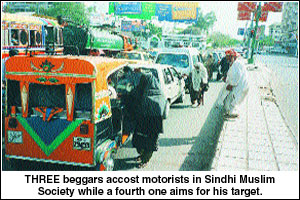
Such scenes are numerous and growing in number steadily. Professional beggars swarm marketplaces, tap on car windows at traffic intersections, knock on doors or press doorbells to seek alms. Some try to grab your sympathy saying that they have come from a distant place to look for lost relatives and now have no bus or rail fare to return home. Some may carry fake receipt books to seek ‘contributions’ for a non-existing mosque or madressah. Some could be more imaginative and are likely to come up with a fresh and more convincing pretext to beg for money.
A journalist suspects that beggar women carrying suckling babies usually have hired ones. “I have observed that these babies never cry and seldom stir. I believe they are given some drug to keep them calm throughout the day.”
Once a group of American businessmen saw a vehicle laden with beggars, they asked the driver to follow them. To their astonishment, the beggars, including able-bodied and handicapped, women and children, were being dropped one by one at various points, a businessmen told Dawn.
Eunuchs too in increasing numbers have joined the begging profession. It is not that they were away from this business previously, but they are now much more visible than before on roads running through the better-off localities, sauntering from car to car.
Some beggars are so persistent that they cannot be shooed away by just saying Muaaf karo, baba. People have their own compulsion to pay the beggars. Sometimes they think it is a good deed to help beggars. Sometimes they just want to get rid of them at the cost of a few rupees. Many beggars are not satisfied with the small amounts people give them, they insist on getting second-hand clothes, shoes or point to a restaurant asking that they be paid enough to buy a meal. Many of those genuinely in need are swamped by the professionals.
In Ramazan the city administration had launched a campaign against the scourge. But it only drove beggars into residential areas from marketplaces and roads. There they kept a low profile and waited for the anti-beggary campaign to peter out.
A large number of professional beggars were arrested. They made some interesting disclosures about the circumstances that thrust them into this trade. One young beggar said his beloved wife was very demanding and did not allow him to enter the house if he could not ‘earn’ Rs350 a day. For a man of limited education and skills, he said, beggary was the only profession that could ensure such a hefty amount daily.
A survey report says that some of the beggars are millionaires, owning cars and buildings. A particular multi- storey building in Saddar is mentioned as belonging to a beggar. Such beggars say that besides it being a high-profit profession, in begging they find a compelling pleasure.
Beggars never admit that they are doing something disgraceful. A woman sitting in a car admonished a well-fed young woman beggar for begging instead of doing some work. Stung by the remark, she retorted: “What do you think we are doing? Is sweating it out all day long on the roads for a few rupees not work?”
The city government last month announced the launch of another anti-beggary drive. But all these efforts seem to be doomed. The beggars’ mafia are fortifying their position. The soaring cost of living and rising unemployment are giving them strength as they can easily induct more recruits into their ranks.
Deserving people have a rightful claim on charity and philanthropy. But they are few and far between. Social activists point out that the government should ensure that such people do not have to ask for alms and instead are helped in an honourable manner.
It is also emphasized that religious and political leaders and NGO representatives should play their role in raising public awareness about professional beggars.