0
0

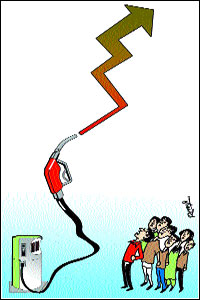 Pakistan is not likely to be affected very much by the threatened oil price hike in the wake of war in the Middle East. We are already getting our oil at highly concessional rates from Saudi Arabia and other Gulf countries. In the case of Saudi Arabia, the supplies are coming on the basis of deferred payment.
In fact even when the world oil prices were sky-rocketing, Pakistan had enjoyed the concessional oil facility from the oil rich Arab countries. But in order to balance the budgets ,the successive governments have always used every price hike in the international oil market to enhance the local prices. So, if the prices go up as a result of the worsening Middle East situation in view of the American threat of war against Iraq, the gainer would be the Pakistani government and the losers will be the general public as well as the business community.
While hiking the domestic prices of oil when the international prices go up despite the fact that we are getting our oil at concessional rates the successive governments have never bothered to consider the impact of this mindless action on the domestic cost of production and the consequent adverse impact on our competitiveness in the export market. Even today while the war clouds are hovering over the Middle East, the Pakistani official planners are viewing covetously at the prospect of making a killing by enhancing the domestic oil prices rather than worrying about the prospects of disruption in the supplies.
The threat of disruption of supplies is more real than the increase in oil prices because of the chances of a slow- down or even total stoppage of ships entering the war zone to pick up oil supplies. Over the years, Pakistan has lived with an oil storage capacity of three weeks only. So, if a war actually breaks out and it lasts for three weeks or if the shipping arrangements are disrupted for three weeks before and after a short war, the country is likely to come to a grinding halt.
The government has so far only projected how much it would make if a war breaks out in the Middle East. It seems to be day- dreaming of making a killing of at least Rs. 60 billion which it would earn by hiking up the domestic oil prices in line with the increase in the international oil prices though most of its imports would be coming from its major suppliers at concessional prices, which even today are lower than the current prevailing world oil prices. While this anticipated unearned income of the government would surely come very handy to cover up the expected shortfall of about Rs. 100 billion in the non-tax revenue, it would still leave a gap of about Rs. 40 billion to bridge. And if due to disruption in supplies which is more likely if a war breaks out then the government would be facing two problems. First it will have to make do with the three weeks’ reserves at least for six weeks and on the other hand the shortage would make it doubly difficult for the government to earn Rs. 60 billion additional non-tax revenues because if the economy slows down and grinds to halt because of lack of availability of oil then tax revenues too would fall too short of the target.
So, all in all the gap to cover would widen to perhaps about Rs. 200 billion because shortage of oil will slow down the economic activities which in turn would cause even the revenue income which is on target to go down steeply. And perhaps by year end the final tax collection would fall short by about Rs. 100 billion. One only hopes that this scenario is not played out in reality because in that case, the pro-poor projects would suffer the most and poverty in the country would further deepen and widen.
Also, the budgetary deficit which is expected to remain within the target this year would once again shoot up to 6-7 per cent because savings from stopping the pro-poor project would not be enough to cover the other parts of the budget sufficiently adequately. The government is supposed to have made a number of contingency plans to meet the situation in the aftermath of a Middle East war. But all these plans seem to be focusing on increase in oil prices and not on what would happen if the supplies themselves were disrupted. And there is hardly any time left now to make such a plan as the war appears to be only a week away.
Even if Pakistan had not had the facility of buying oil at concessional prices and that too on deferred payment basis, it would not have mattered much because today the country boasts of a record foreign exchange reserves of over $10 billion, part of which could have been pressed into service in such an eventuality without the need to cut the expenditures. However, in case the government has to resort to rationing of oil in the eventuality of disruption in supplies, then even the FE reserves would not be able to do anything to ease the situation and save the budget from facing a crisis. We can avert this possibility only if the US postpones or completely cancels its war designs. And this is one more reason for Pakistan to vote against the US-UK resolution in the UN Security Council. But then in this uncertain world there is no way to predict that if war clouds disappear today they would not come back again at some future date. So, it is time for us to take stock of the situation and do something to avert being faced with a similar situation at some future date.
The first thing we should be doing is to expand our oil reserve capacity to at least 60 days. Of course this would entail a lot of capital investment both on building the infrastructure for the purpose and for purchasing oil in such large quantity. But then if we went about the matter in a business-like manner perhaps we could find a foreign private financier or even a consortium to invest in the project.
Secondly, we must invite the foreign oil and gas companies to do a study on the feasibility of exploiting the shallow gas fields which have been abandoned due to their being uneconomic to see if these fields could be put to profitable use say for manufacturing fertilizers and cement or even for running local power plants. If this is found feasible we could reduce our oil needs considerably.