0
0

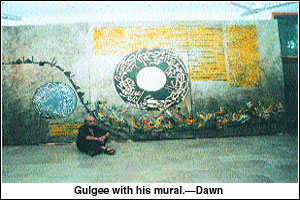 KARACHI, March 13: Noted artist Gulgee has completed a mural, measuring 21 feet by 10 feet, that is intended for Lahore airport.
The mural contains the poetry of Allama Iqbal written in elegant Eastern Kufi and Thulath scripts.
Speaking about his artwork, Gulgee told Dawn on Thursday that the mural, which took him a year to complete, contained the oft-quoted couplet of Ibqal — Khudi ko kar buland itna key har taqdeer say pehlay/khuda bande say khud puchhay bata teri raza kya hai — as the centre-piece. “The reason why this couplet has been selected is that most people in the subcontinent are familiar with it and understand it. Written in Thulath script, the calligraphy acquires the shape of a circle, signifying the cosmos and the feeling of continuity.”
The couplet is written in gold which is the symbol of divinity in all the arts of the world.
The calligrapher noted that the Poet of the East had always placed a great deal of emphasis on excellence. “Iqbal knew that past glory could be regained only by striving for excellence. Starting from a humble beginnings, tribes of Arabia, under the guidance of Prophet Muhammed (Peace be upon him), rose to great heights in all fields of human endeavour just because they sought to gain excellence. Islam pro-mpted them to acquire excellence.”
He said throughout history the attitude of the Muslims towards art and artists had swung like a pendulum from one extreme to the other. “There was a great calligrapher called Hafeez Usman. The ruler of his time was so fond of the calligrapher that he used to hold the inkpot while the artist worked. However, another great artist, Ibn Mughala, who founded the grammar of calligraphy, was killed by the ruler of his time. First, the ruler chopped off his right hand. Then the calligrapher started to write Ayat of the Holy Quran with his left hand until it was also chopped off. The rage of the ruler knew no bounds when he learnt that the calligrapher was writing with his legs. The ruler, then, had the calligrapher killed.”
A large space on the mural is occupied by another phenomenal poem of Iqbal, Masjid-i-Qartaba. Written in Eastern Kufi script, the calligraphy is accompanied by Surah ar-Rahman. Another couplet by Iqbal — Sabaq bhir parh sadaqat ka... — runs across the mural in the form of a wavy line. It is written in Gulgee’s signature script — with lots of golden yellows, greys and blacks — with the same couplet written in Eastern Kufi script underneath. The left part of the mural is occupied by another circular disk which contains Surah Fatiha written in Thulath script in the traditional Tughra style. Under the circular disk, an Ayat is written in what is known as Maghribi script.
In an essay on the art of Gulgee, leading German scholar Annemarie Schimmel wrote: “Gulgee’s work in the various styles of classical calligraphy is amazing, and I can never forget my joy when I was confronted for the first time with the Mihrab in the Faisal Mosque at Islamabad, that enormous prayer niche in the shape of an open book, made of marble, with Surah ar-Rahman written on its pages in powerful golden Eastern Kufi, and the pages bound together by a magnificent mirrored Allah in lapis lazuli.”