



 0
0

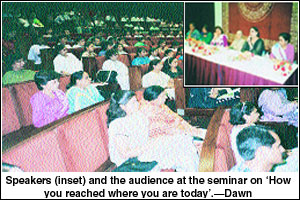 KARACHI, March 10: Speakers at a seminar here on Monday said support of men to the family was an important factor due to which they had attained the status that they had today.
They were speaking at a seminar on “How you reached where you are today,” organized in connection with the International Women’s Day, by the Working Group for Women, in the Aga Khan University Auditorium.
Six women who have achieved excellence in their respective fields were invited to share their experience with the younger generation so that they could learn from their experience and follow in their footsteps to succeed in their lives and careers.
Former Sindh minister Anita Ghulamali, Sindh Information Secretary Mahtab A. Rashdi, anchorperson of television shows Khushbakht Shujaat, the Dean of Aga Khan University’s School of Nursing, Dr Yasmin Amrasi, Aga Khan University’s Marketing Director, Talat Tayyabji, and playwright Haseena Moeen spoke at the seminar. Saniya Saeed conducted the proceedings.
The speakers urged women to properly groom their children, particularly male children, so that they were sensitized on women’s issues. This would make them better human beings with sympathetic understanding of female members of their family.
They said women were exposed to harassment right from the moment they stepped out of their homes, whether for education or employment. They faced harassment in public places, on buses and in offices and other workplaces.
The speakers demanded that specific laws be formulated to stop harassment of women and a support system — free legal aid, shelter homes, etc — be put in place for the victims of harassment.
They pointed out that if women were provided equal opportunities they had proved, and they could prove, that they were not an inferior being.
The speakers said women had to work much more than men to prove their mettle and to gain recognition.
They said it was an erroneous impression that women had more opportunities in the West as the majority of women over there worked as secretaries, teachers, etc, and they were not at the top level decision-making positions, whereas in the East women such as Benazir Bhutto, Indira Gandhi, Srimavo Bandranaike, Hasina Wajid, Khaleda Zia and Cory Aquino had led their countries.
They said it was equally important to create awareness of women’s rights among both women and men to kill the existing prejudice against women.
The speakers said working women had to bear the responsibility of both the home and the workplace, so in order to successfully meet their dual obligations they needed the support of their male family members.





























