0
0

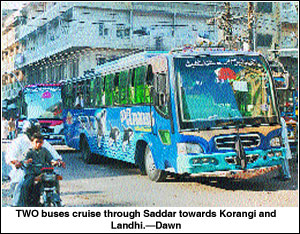 KARACHI, March 9: The buses connecting Landhi and Korangi to Saddar have no equals among the buses of other routes. They run the fastest and, when occasion demands, the slowest. They do not hit other vehicles as many times as they threaten to. They may deny concession in fare to students when they will so. And they inconvenience the women commuters the most.
Entering the Saddar area from across the Gora Qabristan intersection, the buses begin filling up on Mansfield Street and slowly roll down part of Daudpota Road, a few paces from the Empress Market, and move onto Mir Karamali Talpur Road (Napier Street). With other buses on their heels, after a brief pause here they take a leap towards the Lucky Star. Coming onto Sharea Faisal opposite the Regent Plaza hotel, they shoot in the direction of the airport and at the FTC intersection turn towards Defence Housing Authority.
Speeding through parts of Defence, on their way they pass localities such as Qayyumabad, Korangi Crossing, Nasir Colony, and various sectors of Korangi up to No 5. Here they branch out into sub-routes. The 17-J route bus goes straight into Landhi, Babar Market; 17-H to Korangi Market, and 17-K to what is called Sau (100) Quarters. ‘17’, also called Awami, meant for K Area appears to have disappeared from the route. This means the passengers for this locality are now forced to travel by the slower and smaller minibuses of the C-2 route.
Leaving their last stand with a gap of 3-4 minutes, in all, these buses number around 250. They might be slightly fewer than the notorious W-11 ones, but they cannot be compared, as the W-11s belong to the mini tribe.
In fact, the Korangi buses ferry a huge load of commuters across the two points. But they have the least regard for women passengers. Crammed from end to end during the morning and evening peak rush hours, they do not pick up the women desperately waving along the road in an attempt to stop the monsters. Those who somehow squeeze in at some places, find it difficult to breathe freely for men are all around — sitting, clinging to handle bars and standing otherwise. The enclosure for women is market with “for ladies”, but the words serve no practical purpose. Getting off is more of a problem for the harassed women passengers.
Complaints of women commuters do not end here. “I can’t explain how some perverted people behave,” said a woman commuter working in a Clifton office and having to switch to another bus on the way from Korangi 2-1/2. “I wish I could afford to travel by rickshaw and do not suffer the daily humiliation.”
Another factor that makes these buses stand out is music. They play a vast selection of Indian and Pakistani cassettes. It is usually very loud, drowning in its noise the whimpers of quite a few men protesting against the ear-splitting din. A majority of the travellers, however, have developed a taste for it. Some of the passengers even offer their own cassettes to be played. But the audio skits offering an alternative to the music are patently vulgar, manifestly embarrassing the women.
The socalled ‘token system’, aimed to goad the bus drivers into speeding, may have been abolished on some routes, but still exists here. The drivers first rush to get the token, but beyond that point become exasperatingly slow unless there is a genuine provocation from a competitor.
The drivers of these buses are the most reckless. And probably the most skillful, too, as they have to their credit more misses than hits. But part of this credit goes to the drivers of smaller vehicles on the route. For fear of being rammed, they move out of the way of these jumbos instantaneously.
These buses are taken off the long routes, where they can no longer compete with brand new, airconditioned buses. But fresh on these city routes, they are very good compared to their decades-old, tired counterparts on many other routes. Much of the bus fleet is well maintained. Even those which have rickety interiors, with torn-off seats and dirty looks, speed neck-in- neck with their challengers.
Overall they are the finest specimen of their variety. However, a comparison between these buses and the newly-launched ‘green’ buses running on a couple of routes would be unrealistic. The ‘greens’ charge several times more than the Korangi buses do.
The Korangi-Landhi boys travelling in these buses give the drivers and conductors very tough time. They prod them into keep moving and speeding. Most drivers have, however, learnt how to tackle them — to have a sharper tongue than the boys’.
Broken roads are no problem for these buses as they fly off potholes and bumps, but are for the passengers who receive violent jolts.
Students complain that some bus operators refuse them concession on their cards. Operators of a particular bus of the 17-K route, known as ‘Columbus’, are the most ruthless. For charging full they offer the excuse that it entertains the passengers with a VCD player. “Who can watch the movies in a bus packed like sardines in a can?” says a college student, who wants the authorities to take note of this anomaly.
The buses have their individual identification also with some very imaginative names such as Mr Chief, Romeo, Al-Shah Rukh, Al-Sameer Shangri-la, Black Queen, Jhoolay Laal, Shandar and Attar ki Deewani.