0
0

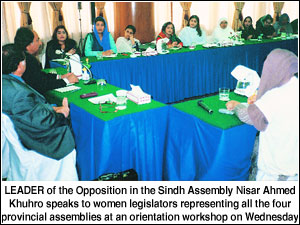 KARACHI, March 5: Speakers at a workshop urged the women parliamentarians to rise above the party politics, form a bloc and formulate a joint strategy for the women’s rights issues when they come up for discussion in the parliament or assemblies.
The three-day orientation workshop, for women members of the provincial assemblies, which concluded here on Wednesday, was organized jointly by the Jinnah Institute and the London-based Westminster Foundation for Democracy.
The nine speakers, prominent figures in their respective fields, spoke to the 24 women MPAs from all the four provincial assemblies.
This was the second workshop of the series after one organized for the members of the national assembly. The third workshop is to be organized by senators in Islamabad soon.
The women legislators were advised to study carefully the draft laws when presented as bills in the House, do their home work properly and participate in the assembly debates keenly to express their point of view effectively.
The Leader of the Opposition the Sindh Assembly, Nisar Khuhro, said thatopposition was an essential part of the parliamentary democracy. If it stayed away from the House proceedings, any move by the treasury benches with regard to legislation, debate or a change, etc. was bound to lose credibility among the local people as well as international community, he added.
He observed that MPAs usually showed much interest in question hour and appeared enthusiastic in embarrassing ministers. However, he added, they did not show the same enthusiasm in legislation business. He stressed that law making was the basic function of an assembly and legislators must participate in this process to ensure that better laws were enacted for the welfare and benefit of the people.
While speaking on the importance of the elected house, Mr Khuhro pointed out that even the prime minister of Britain, where democracy was recognized as ‘mother of all democracies’, responded to the MPs’ questions personally. But, he regretted, in our country the PM most often nominated any of his cabinet colleagues to appear before the legislators on his behalf.
Kanwar Khalid Yunus, an MQM MNA told the women MPAs that a true devolution could begin with the process of decentralization and transfer of finance management affairs to the provinces and the lower tier. He observed that at present, the district governments were being strengthened at the expense of the provinces.
He recalled that in the past, attempts were made under government policies to take the port city’s industry away and incentives were meant only for selected areas where rapid industrialization was contemplated. However, he pointed out, all these policies failed and the whole plan proved an exercise in futility causing colossal losses to the nation.
He demanded that infrastructure be developed in Sindh, the National Finance Commission be revised and a consensus formula for the distribution of resources, be adopted so that all the federating units were satisfied.
He regretted that even much of the agricultural land distributed in Sindh after the construction of dams and barrages was given to the people belonging to a particular province or those in a particular profession. This injustice, he added, had created resentment among the local people.
Senator Sanaullah Baloch said that sanctity of the Constitution had never been maintained in this country. He said this attitude created mistrust and, at times, hatred among the provinces.
He pointed out that the Constitutions had three lists — the federal list, the concurrent list, and provincial list — to deal with different subjects and issues. He said there was no provincial list in the 1973 Constitution and the provinces felt cheated. At the time of adopting the Constitution, he added, it was assured that concurrent list would be changed into provincial list, but it had not been done in more than 30 years. He suggested that the provinces be given similar rights that were enjoyed by the federating units of the USA.
He said that procedure to distribute the resources under NFC should be changed. He urged the women MPAs to make efforts to understand the point of view of others instead of getting excited on various issues. He urged them to avail the opportunity of a long debate in order to modify a draft law in accordance with the aspirations of the masses.
Others who spoke at the workshop were Dr Kaiser Bengali, Kamal Azfar, Dr Mohammad Waseem, Najam Sethi, Daniyal Aziz, and Anis Haroon.