



 0
0

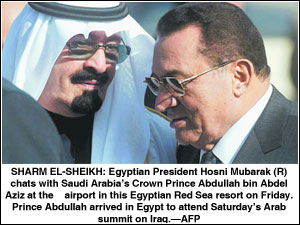 SHARM EL-SHEIKH (Egypt), Feb 28: Arab foreign ministers dismissed on Friday U.S. pressure to urge Iraqi President Saddam Hussein to resign, as Arab leaders arrived in Egypt for talks on bridging long-standing rifts and averting war.
While gaps remained between the 22 Arab League members on how to tackle the Iraq crisis, several ministers meeting on the eve of Saturday’s summit in Egypt’s Red Sea resort of Sharm el-Sheikh said there was broad agreement to search for peace and not meddle in Iraq’s affairs.
Delegates said disputes remained over the wording of a summit communique on Iraq, particularly on issues like the rejection of the use of force, the extent of Iraq’s cooperation with the United Nations and whether Arabs should dispatch envoys to key capitals to explain their views.
But they said any decision would be reached by Arab consensus, and not under pressure from the United States.
“This is a meeting of the Arab League and it is for the Arab leaders to decide what they want to say and what sort of resolution they will come up with,” Egyptian Foreign Minister Ahmed Maher told reporters.
U.S. Secretary of State Colin Powell said on Thursday he would encourage Arab leaders to issue a strong statement at their summit demanding Iraqi compliance with U.N. disarmament requirements, or even suggesting the Iraqi leader go into exile to spare his country a war.
“If you start telling me that to avoid war you have to start changing leaders, that certainly would be an innovation in international law that I am not aware of,” Maher said.
Libyan African Unity Minister Ali Abdesselam Triki said: “I don’t think this is a solution, to step down. This belongs to the Iraqi people to decide. It is not (up) to the Arab summit or Mr Powell to decide on that.”
RIFTS REMAIN: Iraqi Foreign Minister Naji Sabri said President Bush, not Saddam, should resign to spare the world a war.
“He should step down because he is a reckless dictator, a reckless despot who does not respond to the voice and opinion of millions of people. He is driving the whole world and driving his own country to danger,” Sabri said.
Iraq’s delegation to the summit is headed by Vice-President Taha Yassin Ramadan and Izzat Ibrahim, vice chairman of the Revolutionary Command Council, who arrived in Egypt on Friday.
While Arabs oppose an invasion of Iraq, there are deep rifts between U.S allies like Egypt and Gulf states, and states such as Syria.
Several Arab states host U.S. troops and may be springboards for any attack on Iraq.
Analysts say they doubt the summit could help prevent war. They say Arab states lack the leverage to influence either Iraq or the United States, and that differences between members are likely to water down any joint statement.
Arab League Secretary General Amr Moussa told Egypt’s official MENA news agency that a failure to reach a unified stance “might threaten the entire Arab system”.
In the heart of Cairo, some 5,000 worshippers protested amid tight security inside the grounds of Al Azhar mosque against a possible attack on Iraq. “We will die so Iraq can live,” chanted some, while others urged Arab leaders to prevent an invasion.
Egypt’s Maher has said Arabs must work until the last possible moment to help avert a war, which Arabs fear could destabilize an already volatile region.
He said he hoped Iraq’s decision to destroy its Al Samoud 2 missiles in line with a U.N. request was “a new beginning for avoiding war”, but called on Baghdad to do even more.
“This is the subject and this is our main concern in this conference, and surely this step, if implemented swiftly, will contribute to the goals that we are pursuing through this conference,” Maher said.—Reuters



























