0
0

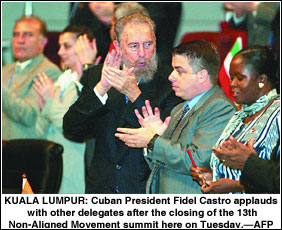 KUALA LUMPUR, Feb 25: The Non-Aligned Movement (NAM) on Tuesday rejected any invasion of Iraq not sanctioned by the United Nations, but pressed Iraq to cooperate “actively” with weapons inspectors.
The NAM ended its summit with the adoption of several resolutions focusing on the conflict in Iraq, unrest in the Korean peninsula and the Middle East turmoil.
High on the list of discussions throughout the two-day summit was the Iraq crisis and issue of weapons disarmament.
At the proposal of host Malaysia, a separate statement on the movement’s stand on Iraq was released, stating that member countries were opposed to any attacks on Iraq and were committed to maintaining international peace and security in the region.
The leaders sent out a strong anti-war message, and called for members, who make up most of the developing world, to remain united in order to remain a relevant movement in the international community.
The NAM believes war on Iraq “will be a destabilizing factor for the whole region, and that it would have far reaching political, economic and humanitarian consequences for all countries of the world”, the 116-nation body said in a statement at the end of a summit here.
“We reaffirm our commitment to exert our efforts to achieve a peaceful solution to the current situation,” it said.
“We welcome and support all other efforts exerted to avert war against Iraq and call for the persistent continuation of such efforts based on multilateral as opposed to unilateral actions, and reaffirm the central role of the United Nations and the Security Council in maintaining international peace and security.”
Iraqi Vice President Taha Yassin Ramadan earlier told the summit that Baghdad was determined to iron out all its problems over weapons of mass destruction to avert war, but denounced the United States for “trying to dominate the world”.
“Iraq is determined to continue its efforts to help with verification of all problems if (the UN) requests details,” he said.
He also condemned “the phenomenon of unipolar politics which seeks to dominate the world on the political and economic levels and to interfere in the internal affairs of other countries through force and aggression”.
The two-day summit has been dominated by the Iraq crisis, with six NAM members — Pakistan, Syria, Cameroon, Chile, Guinea and Angola — due to vote on a second UN Security Council resolution submitted by the United States, Britain and Spain.
DEBT RELIEF: The world’s developing nations proposed new debt relief measures to haul struggling economies, especially in Africa, out of poverty as they called on Tuesday for a fairer global economic system.
The 116-nation Non-Aligned Movement (NAM), in a document issued after a two-day summit, expressed “alarm” over the growing burden of debt payments in many developing nations.
It singled out Africa as most in need of help, noting that the continent’s economic situation remained “precarious” amid a decline in official development aid (ODA) and foreign investment.
Foreign investment to Africa accounts for only two per cent of total flows to developing countries, and its share in global trade accounts for less than one per cent.
NAM proposed a “temporary standstill” on debt repayment from least developing nations, most of which are in Africa, debt cancellation and restructuring, and “debt-for-sustainable-development swap arrangements” to haul the continent out of poverty.
But it warned such debt relief must be separated from ODA resources and must not impose any unfair burden on them.
NAM leaders urged developed countries to grant duty-free market access to least developing nations, and rejected attempts to link trade with labour, environment, social and human rights standards as “pretexts for restricting market access or aid and technology flows”.
They urged the international community to create a “dedicated multilateral mechanism of international financing” for infrastructure development to spur economic growth in developing countries.
NAM, which groups poor nations in Africa, Asia and Latin America, pressed rich nations to fulfil a UN target of 0.7 percent of Gross National Product (GNP) as ODA for developing countries.
NAM leaders said they remained “deeply concerned” over the marginalization of developing nations in the process of globalization, as they face barriers to markets, capital and technology.
They urged an “equitable international economic order” that allowed developing countries to have a say in decision-making on world economic problems.
The movement called for more effective regulation and greater transparency of financial markets, including currency trading, to prevent financial crises.
It underlined the need for effective surveillance and early warning systems to protect developing countries against the excessive volatility of short-term capital flows and international speculation.
With more than 113 million children having no access to primary education and 880 million adults illiterate, NAM called for accelerated progress towards education for all to narrow the global wealth divide.
DOCUMENT: Delegates released a 70-page document containing the movement’s stand on issues discussed and agreed upon during the meeting.
The heads of state expressed concern over the continued division of the Korean peninsula and reaffirmed their support to the Korean people to reunify their homeland through dialogue and negotiations.
The document also expressed serious concern over the issue of North Korea’s withdrawal from the Non-Proliferation Treaty (NPT).
In the much watered-down statement, following objections from Pyongyang, the delegates called upon all parties concerned to do everything possible to resolve the nuclear issue peacefully, including through dialogue and negotiations.
At a media conference after the closing ceremony, Malaysian Prime Minister Mahathir Mohamad, who will head the movement for the next three years, said that the priority for NAM would be to focus on the Israel-Palestinian conflict as well as the threat of war in Iraq.
Mr Mahathir said the movement was strongly against war, whether it is multilateral or unilateral, but told reporters he believed that the U.S. would launch attacks on Iraq despite international opposition.
“I hope there will be no war, but I suspect there is going to be a period after war (for Iraq),” he said, adding that he hoped the U.S. would take notice of the anti-war stance adopted by members of NAM.
Also released at the end of the summit was the Kuala Lumpur Declaration, which spelled out member countries continued commitment in the revitalization of NAM, the theme of the summit.—AFP/dpa