



 0
0

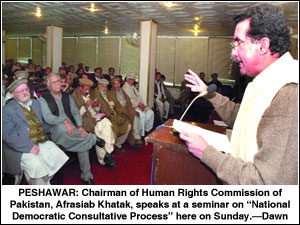 PESHAWAR, Feb 16: Speakers at a seminar here said that if Pakistan continued its policy of intervention in Afghanistan’s internal affairs, trade and economic activities could not flourish in this part of the world.
The maiden seminar of the recently-launched National Democratic Consultation Process (NDCP) was held on Sunday.
The speakers warned that if Pakistan continued to support extremist elements in the neighbouring countries, it might not be able to maintain its present structure.
They said that a new social contract was required between the state and society as the former had gone out of the latter’s control. The Chairman of Human Rights Commission of Pakistan, Afrasiab Khattak, explained the purpose of NDCP’s creation. He said its key goal was to see that Pukhtoon nation controlled its own resources and lives.
He said that in the wake of 9/11, important developments had taken place on the international and national scene, especially in the Pukhtoonkhwa.
“These developments have turned Pukhtoonkhwa into a unipolar region where forces of religious extremism are present whereas democratic and progressive forces are non-existent,” Mr Khattak said.
He said the Muttahida Majlis-e-Amal was neither indigenous nor spontaneous. Rather, it was brought forth by the forces who had been supporting aggression in the neighbouring countries.
He said a consensus had emerged on the global level that from one state’s soil, non-state players must not fight against another state. Moreover, lethal weapons should not be in private possession. He said Pakistan had been acting contrary to these consensus developed after Sept 11, 2001.
He dispelled the impression that the process was aimed at launching any new political party, saying that they had also contacted political parties and provided them with the concept paper of the process in order to seek their proposals.
“This process is inclusive as we have not been excluding any group in the Pukhtoonkhwa from it,” he said.
Mr Khattak claimed that the Pukhtoons were the first secular and democratic nation in this region. He said that in the past, the Pukhtoons were victimised for their secular and democratic thinking as they were persecuted by the state. “Now the same forces are trying to portray them as extremists,” he said.
He regretted that the supporters of extremism had been trying to establish that the tribal people had been providing refuge to Al Qaeda remnants.
“Due to tribal code of life, the Al Qaeda elements cannot hide in the tribal areas as in that setup a stranger or a guest is not taken inside the residences,” he added.
The important Al Qaeda members were arrested from Punjab, and not from the tribal areas or Pukhtoonkhwa, he maintained.
Jamaluddin Khan highlighted the economic problems of the province and said the Pukhtoonkhwa had the potential to generate 50,000 to 70,000 megawatts of hydel power.
He said the federal government had capped the net profit on hydel power generation of this province at Rs6 billion, and was not willing to provide the amount indicated by the provincial government in its annual budget.
Mr Khan said it was the need of the hour to introduce a new social contract for a genuine and equitable federal structure in which provinces controlled their resources.




























