0
0

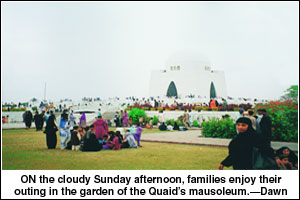 KARACHI, Feb 16: As the city’s weather is drifting to the hotter side, the the Quaid’s mausoleum has begun to attract big crowds. Holidays, of course, pull in larger numbers of visitors than the weekdays. By the fall of dusk, the multitudes swell to their maximum.
With greenery all over, the beautifully paved walks and the fountains playing in bright lights in the evening, the garden embracing Karachi’s most prominent landmark has also become an important recreation spot for families. Children frolicking about on the lush lawns with their parents looking on just add colour to the beauty of the spot.
And situated in the heart of the sprawling city which is starved of proper recreation facilities near homes, the mausoleum of the Father of the Nation is a handy place. Linked with scores of bus and minibus routes, it is accessible to people from all directions.
The recent opening to the public of the museum housing the Quaid’s personal effects is another good reason for people to revisit the place.
The museum, which is part of the mausoleum complex, has the largest collection of the Quaid-i-Azam’s personal belongings under a single roof. The two cars that had been in the use of the great leader sparkle close to the museum entrance. His tables, chairs, rare photographs, letters, crockery sets, a bedding, clothes, gifts presented to him on various occasions, golf clubs and much more are on show. All the exhibits are preserved in glass casings in good condition. Although a fee of Rs3 a person is charged, people throng the place every evening. They have to be kept moving to make room for others.
A visitor may have to pay up to Rs10. The usual entry fee is Rs3, but people complain that during rush time they have to part with as much as Rs5 a person.
The caretakers of shoes charge Rs2 for a pair. There is Rs3 fee for entry to the museum. Parking charges are Rs5 for a two-wheeler, Rs10 for a car and Rs30 each for larger vehicles. The daily timings are from 10am to 9pm.
Most people say the fee for entry to the mausoleum is quite unjustified. “People come here to pay their respects to the Quaid-i-Azam. Asking them to pay for going to the mausoleum, even this nominal fee, is an act of shame,” said a visitor.
An official, however, said: “Realistically speaking, the maintenance cost is very high. And it has to be earned. The amount that a visitor pays is just paltry.”— Naseer Ahmad