0
0

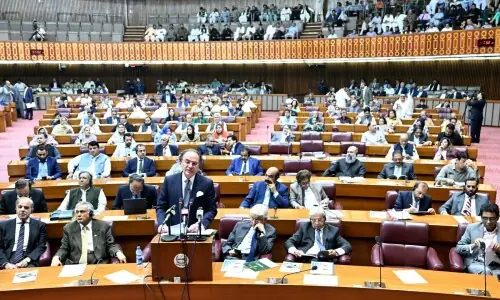
KARACHI, Jan 30: The Sindh Assembly on Thursday unanimously adopted a resolution calling for setting up a new National Finance Commission and suggested that the federation should be entitled to a 55 per cent share of the divisible pool against its existing share of 62.5 per cent.
The share should be computed on the basis of each province’s population, the resolution said.
The resolution was jointly tabled by the Muttahida Qaumi Movement’s Syed Sardar Ahmed from the treasury benches and leader of the opposition Nisar Khuhro.
When the resolution was adopted, Chief Minister Ali Mohammad Mahar was conspicuous by his absence, though earlier in the day he had briefly come to the house.
The joint resolution was an amendment to the motion moved on Tuesday by the MQM’s Akhtar Mehdi Bilgirami, asking the provincial government to approach the federal government for an expeditious, just and fair decision on the NFC acceptable to Sindh.
The current formula was termed by Sindh legislators on Tuesday as biased and heavily tilted against the smaller provinces, especially those generating high revenue. The situation had resulted in a polarization between federal government and the smaller provinces.
The Sindh Assembly called upon the provincial government to approach the federal government to constitute a new national finance commission for the distribution of the gross proceeds of the divisible pool between federation and the provinces for a period of five years with effect from July 1, 2003.
According to the proposed formula, “the federal government shall maintain accounts of the gross divisible pool taxes that include general sales tax on services and such taxes as collected from each province, specified under para 3 of the Distribution of Revenues and Grants-in-aid Order 1997”.
The Sindh Assembly also proposed that after deduction of five per cent collection charges and payment of three per cent and two per cent, respectively, to Balochistan and the NWFP as subvention, the federal government would credit the net proceeds of the taxes collected from each province into the provincial exchequer.
Sindh also wants the net proceeds of the divisible pool taxes to be distributed between the federation and the provinces in the ratio of 55:45, respectively.
It is proposed that the federation should be entitled to receive its 55 per cent share from the provinces on the basis of their population.
Accordingly, after payment of its share to the federation on the population basis, each province will be entitled to retain the amount of divisible pool taxes collected in its jurisdiction and credited.
It was also proposed that a deficit province might borrow from the surplus province on mutually agreed terms and conditions.
The Sindh Assembly, however, maintained that the policy of straight transfers to the provinces, as provided under the NFC Award of 1997, would be maintained for another five years unless unanimously revised earlier by the provinces.
After tabling the resolution, Home Minister Syed Sardar Ahmed said the new formula had been devised because the system existing for the last 40 years had proved detrimental to the interest of the smaller provinces. He emphasized that the motive was not to snatch away the rights of other provinces.
Terming the resolution a “serious landmark decision”, leader of the opposition Nisar Khuhro said it had vindicated his party’s stand that the 1997 NFC Award, which was imposed on the people of Sindh by a non-elected regime, had caused serious loss to the province and had thus retarded human and economic development.
He said the government had now been vested with the collective and unanimous resolve of the people of Sindh, and a test of its determination would come when the matter would be taken up with the federal government.
He welcomed the realization among the authorities that during the past five years, Sindh had lost about Rs80 billion as the federation doled out much less than the required amount to Sindh.
Mr Khuhro said it was good that the Muttahida Qaumi Movement had now realized the loss Sindh had suffered since 1997. Although it was a major partner of the regime at that time, it had not taken such a radical stand.
He said that while the government was busy paying back the State Bank’s overdraft, it had very little to take care of human development.
According to Sardar Ahmad, in the 1997 NFC Award the following formula was adopted:
He said it was evident from the above statement that Sindh had anticipated a share of Rs173.209 billion from the divisible pool in four years, as projected by the National Finance Commission (NFC), but it actually received Rs104.472 billion only, a shortfall of Rs68.737 billion.
According to the World Bank Report (Sindh: Fiscal Resource Study), “the magnitude of the variation so soon after the award and the absence of any contingent arrangements in the Award, are serious shortcomings of NFC 1996-97”.
The above figures unequivocally led to the conclusion that the strategy adopted by the federal government for apportionment of national resources between the Centre and provinces was skewed. It failed miserably to perceive a co-relation between the generation of resources by the provinces and the allocations made by the federal government to the provinces on the basis of the NFC recommendations.