



 0
0

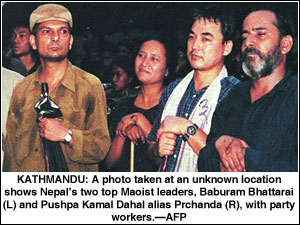 KATHMANDU, Jan 30: The Nepalese government will call all-party talks to map out the country’s political future following the clinching of a landmark ceasefire deal with Maoist rebels, a senior minister said on Thursday.
Maoist leaders committed themselves to upholding the ceasefire announced on Wednesday night and warned that those violating the truce would be regarded as “traitors”.
Public Works and Transport Minister Narayan Singh Pun, the appointed chief government negotiator, said the immediate next step would be face-to-face talks with Maoist leaders, possibly as early as next week.
These would be followed, he said, by a round-table conference with representatives of all political parties, civil society and human rights groups.
The Maoist rebels, who have been waging a seven-year “people’s war” to topple the constitutional monarchy that has claimed 7,800 lives, and the Kathmandu government announced late Wednesday a mutual ceasefire and said peace talks would begin in “a couple of days.”
Pun said Thursday the date and venue of the talks had yet to be fixed and that government was working out the logistics with rebel leaders.
“We are going to deal very carefully so that the ceasefire declaration by the Maoist leaders will be effective and leads to a cessation of all activities by the Maoists,” he said.
There would be a written agreement between the government and the Maoists to formalise the ceasefire declaration, he said.
The rebels’ demand for a republic, that a new constitution be drafted and that elections be held for a constituent assembly, he added, would be discussed at the round-table talks.
“They will be discussed gradually when we sit for the peace dialogue,” Pun said.
Addressing the media at the Reporters’s Club here Thursday, Maoist mediator Dadhi Raj Lamichhane said he believed the round-table talks would help forge a new political order in the Himalayan kingdom.
“We are going to discuss all issues, including the modality of the new coalition government and constituent assembly elections to redraft the constitution,” Lamichhane said.
He read out a statement by the Maoist leadership committing itself to uphold the ceasefire.
“If anyone from either side violates the ceasefire, they should be branded as traitors,” Lamichhane said in response to a question.
Nepal’s political leaders, including the president of the Nepali Congress party, former premier Girija Prasad Koirala, and Nepal Communist Party-United Marxist and Leninist general secretary Madhav Kumar Nepal, Thursday cautiously welcomed the ceasefire declaration but bitterly criticised the government.
Nepal complained the government had not taken political leaders into its confidence nor had it briefed them on the terms and conditions of the ceasefire agreement.
Wednesday’s breakthrough, according to a senior leader of Prime Minister Lokenda Bahadur Chand’s National Democratic Party (NDP), had come about through the direct intervention of King Gyanendra.
The source told AFP the king held marathon talks with rebel leaders in his palace here on Monday.
Political analysts said the fact the king appeared to be driving the process and seemed ready for a political compromise on some of the rebels’ key demands augured well for the peace process.
An earlier ceasefire called in July 2001 led to peace talks but these collapsed after three rounds of negotiations when the government refused to budge on the demands for a constituent assembly.
Chand was appointed in October by the king, who had dismissed elected premier Sher Bahadur Deuba as “incompetent” in dealing with the Maoist insurgency.
Indian reaction: India on Thursday said it favoured a peaceful resolution to the conflict in Nepal.
“To achieve peace, security and stability in Nepal, we believe that the process of dialogue should be based on national consensus, should include political parties and should be conducted in an environment free from violence,” external affairs ministry spokesman Navtej Sarna told reporters in New Delhi.
Sarna said India continued to regard multi-party democracy and constitutional monarchy as the “two pillars for stability” in Nepal.—AFP



























