UN inspectors seek more time: Iraq asked to give account of chemical material; US presses for action


 0
0

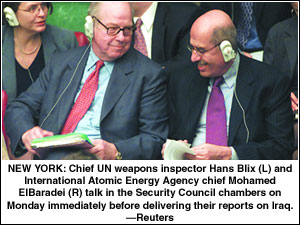 UNITED NATIONS, Jan 27: The chief UN weapons inspector, Mr Hans Blix, and the Director General of the Inter-
national Atomic Energy Agency, Mr Mohammed ElBaradei, on Monday asked the Security Council to give the inspectors more time to complete their work in Iraq. However, they criticized Baghdad for resisting international efforts to ensure its disarmament
Giving the UN Security Council a progress report after 60 days of inspections in Iraq, Mr Blix said: “Iraq appears not to have come to a genuine acceptance, not even today, of the disarmament which was demanded of it”.
UN inspectors have been searching for evidence of weapons of mass destruction since November under Security Council resolution 1441, which orders Baghdad to disclose all weapons of mass destruction and related material.
Mr Blix observed that Iraq had failed to account for large quantities of poison gas and anthrax. He said there was a “strong evidence” that Iraq maintained quantities of anthrax after it claimed to have destroyed its stocks.
The inspectors’ chief said the discovery of empty rocket artillery shells capable of carrying chemical weapons shows “that Iraq needs to make more effort to ensure that its declaration is currently accurate”.
Although Iraq had “cooperated rather well” in granting inspectors access to all sites they wanted to visit, including private residences, Blix said: “It is not enough to open doors.”
ElBaradei said his inspectors had been unable to verify whether Iraq had an active nuclear weapons programme. But he urged Security Council members to let the inspection process “run its natural course”.
“Barring exceptional circumstances and provided there is the sustained, proactive cooperation by Iraq, we should be able in the next few months to provide credible assurance that Iraq has no nuclear weapons programme,” ElBaradei said.
“These few months, in my view, would be a valuable investment in peace because they could help us avoid a war.”
The Bush administration quickly reacted to the report, saying that Iraq was not in compliance and the United Nations needed to reassess its approach to the situation.
“In the days ahead, we believe the council and its member governments must face its responsibilities and consider what message council irresolution sends to Iraq and other proliferators,” said John Negroponte, the US ambassador to the United Nations.
According to diplomats, the council’s 15 member nations will hold closed-door discussions on the inspectors’ report on Wednesday.
Agencies add: The chief UN weapons inspector told the Security Council that Iraq had cooperated with his investigators, but left many questions about its chemical and biological weapons unanswered.
Contrary to the expectations of many diplomats, Blix did not directly ask the council for more time to complete the inspections.
Before the briefing, Annan told reporters that he expected the council to give the inspectors more time.
“If they do need time, they should be given the time to do their work,” Annan said. “I suspect the council will allow for that time,” he added.
The United States has clashed with other key council members over the need to give more time to the inspections, but Mr Blix alluded only obliquely to the question.
The unanimity of the council in adopting Resolution 1441 on Nov 8 last year “sent a powerful signal” to Iraq, he said.
Since then, the UN Monitoring, Verification and Inspection Commission (UNMOVIC) had developed “an inspection apparatus that permits us to send multiple inspections teams every day all over Iraq, by road or by air”, he added.
That apparatus was “at the disposal of the Security Council,” he said.
“It would appear from our experience so far that Iraq has decided in principle to provide cooperation on process, notably access,” Mr Blix said.
“A similar decision is indispensable to provide cooperation on substance” if Iraq were to disarm peacefully, he said.
It had provided prompt access to all the sites the inspectors wanted to visit, including palaces of President Saddam Hussein, he said.
The formal declaration of weapons of mass destruction Iraq submitted on Dec 8 “contains a good deal of new material and information” about missiles and biotechnology since 1998, he added.
But it contained no new evidence to resolve questions about its earlier weapons programmes, he said, giving several examples.
The UNMOVIC had information “that conflicts” with Iraq’s claim to have produced a small amount of the nerve agent VX and to have destroyed it all in 1991, Blix said. There were also signs that Iraq had weaponized the agent, “one of the most toxic ever developed”, he said.
Iraq had also failed to account for 6,500 chemical bombs which it said were used by its air force during the 1980-1988 war with Iran, he said.
He recalled Iraq had declared that it produced 8,500 litres of anthrax — a powerful potential biological weapon — and unilaterally destroyed the stock in the summer of 1991.
Not only was there “no convincing evidence of destruction”, there were “strong indications” that it produced more than it declared, and that some stocks might still exist, he said.
Blix said he did not presume that Iraq had such weapons, but neither did he presume the opposite.
“Presumptions do not solve the problem. Evidence and full transparency may help.”
He noted that despite UN sanctions, Iraq had illegally imported “as late as Dec 2002” about 300 rocket engines that might be used for a missile programme.