



 0
0

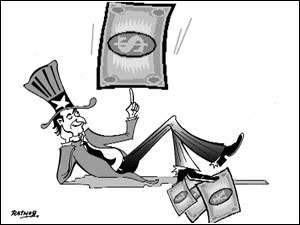 Prime Minister of Malaysia Mohammad Mahathir, during his recent visit to Japan sometime back, called for introduction of international currency (IC) implying replacement of the omnipotent US dollar, as the world currency, as is the case at present.
It is a very wise suggestion, but unlikely to be materialized soon, as this would strike at the very heart of the USA’s economic world domination. But if other countries of the world, particularly the South, strive for it, this may come about sooner than later.
One notes that the USA is the largest deficit nation in the world and yet manages to import from around the world much more than what it exports; and spends hugely, rather wastes on matters such as uncalled for wars. How does it manage to do so, without going down from the pinnacle of economic heights, unlike Japan, which slided within a decade or so ? In fact, the US Senate has passed a law recently, cutting down tax amounting to an almost unimaginable limit of $1.65 trillion (i.e. $1650 billion) covering a period of one decade. This averages to $165 billion a year, allowing a refund of $ 600 per head to each of the over 270 million US citizens every year for ten-years in succession.
Even Malaysia itself was shaken down some time back, when its currency was attacked by an international speculator, Soros. There was immense pressure on Malaysia to devalue its Ringgit, but with a wise leader as Dr.Mahathir Mohammad, Malaysia escaped the consequences of the inadvisable steps that other nations led by weaker leaders would have taken.
We vividly remember the foreign currency account (FCA) freezing in Pakistan’s case, when faced with a difficult situation. US currency, at present, is the only currency, that is acceptable at every nook and corner of the world, even in retail markets. To the extent that in many countries it is favoured more than the local currency. Rather, dollarization, at the cost of local economy, flourishes. Why ? It is because, while the local currency gets devalued (against the US dollar) no such risk exists in case of the dollar because of the ever vigilant Bretten Woods sisters around?
But what if there was a currency existent, say, the international currency as proposed by the Malaysian Prime Minister? That is the crux of the matter. All the hullabaloo going on against the globalisation around the world at present, against the World
Bank and the International Monetary Fund (IMF) would succeed in its aim of curbing the menace of exploitation, and which is nothing but progress of the rich countries at the cost of the poorer ones of the world — being pushed around by the WB and the IMF on behalf of their masters.
It is high time the poorer nations of the South gather together, and decide to come out of the current whirl-wave that, no matter how hard they try, only pulls them down instead of progressing, because of the pre-programmed strategy of the sole super-power, in tandem with the WB and the IMF, whereby it remains the only country in the world that has so far unwritten right to print its own currency without limit, on account of the international acceptability of the almighty dollar, as stated above.
The USA may import, say a hundred billion dollars worth of goods from China, but export only half that amount to it. This is good in case of all countries that the USA deals with. So the USA may import a trillion dollars worth of goods from around the world while exporting only half that amount to the world, and compensate for the resultant GDP deficit, by printing dollars without any limit. To combat inflation at home, the excess US currency is exported worldwide.
All countries of the world, through their central banks, keep a tab on the total amount of their currency in flotation, at any given time. Does anyone care or cared in the past, to know (except the US and the Bretten Woods sisters), how much US currency is in circulation around the world at any given moment ? It maybe more than the local currencies of all the countries of the world combined.
It is time to accept Dr. Mahathir Mohammad’s suggestion, if any meaningful change for the better is ever to be brought about in the world economy, especially for the benefit of the poorer countries.






























