0
0

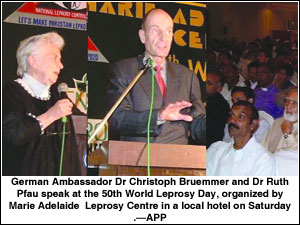 KARACHI, Jan 25: Speakers at a function on Saturday said that after controlling leprosy effectively the Marie Adelaide Leprosy Centre (MALC) was now trying to control TB and eye diseases in the country.
They were speaking at the function organized by the MALC to observe the 50th World Leprosy Day. They said that 50 years back a French human rights activists and a great friend of leprosy-affected people, Raoul Follereau, who had worked all through his life for the world’s oppressed minorities, celebrated the first World Leprosy Day on Jan 31, 1954.
The chief guest on the occasion, German Ambassador Dr Christoph Brummer, said that after controlling the disease in the country the next challenge before the MALC was to create awareness among the masses so that they did not hide or outcast the patients but brought them to the hospital soon when they came to know of the disease. He said cured patients must be accepted into the family and society and given love and care.
Earlier, MALC doctors said that after achieving the target of controlling leprosy in 1996, the National Leprosy Control Programme had moved on to the second phase of making the country free from leprosy.
They said that Pakistan was the first country in Asia that had controlled leprosy in 1996 some four years ahead of the WHO-targeted date. With nearly 50,000 patients registered, majority of them cured, the MALC staff continued to look around for an estimated number of 20,000 hidden cases.
They said that with the decreasing case load, the paramedical workers were being trained in TB control and prevention of blindness strategies.
They said that future goals of the MALC were to empower 12,000 disabled patients and to rehabilitate 5,500 patient who had social problems. One of the major aim of the MALC, they said, was to restore human dignity and social rights of leprosy-affected people so that they were treated like normal human beings.
In his message read out at the function, chief of International Federation of Anti-Leprosy Association, Dr Sunil Deepak, said though the medicines to cure the disease had been invented, the transmission of the disease had not yet been controlled and one new case of leprosy was being diagnosed every minute.
The message said that since the available evidence suggested that a significant leprosy problem would continue to exist for many years to come, so the services to detect and manage the cases of leprosy must therefore be sustained.
Adviser on leprosy to the federal government, Dr Ruth Pfau, Ashfaq ali Khan, Sr Berenice Vargas, Mutahir Zia, Peria Swami, Ghazala Ahmad and others also spoke.
Earlier, children presented a tableau and a skit highlighting the issue. Later, the staff members who served the MALC for over 25 years were given gold medals.