



 0
0

 DAVOS (Switzerland) Jan 25: US Secretary of State Colin Powell said on Saturday he had had an “extensive discussion” with Turkey’s leaders on the use of Turkish bases for a possible attack on Iraq.
“We had an extensive discussion about these matters,” Powell said after meeting for about 75 minutes with Turkish Prime Minister Abdullah Gul and ruling AKP party leader Tayyip Erdogan on the sidelines of the World Economic Forum.
Asked if there were any deadlines for agreement with Turkey on the issue, Powell said: “We didn’t discuss deadlines, they have a good sense of the timing that’s involved.”
Gul called the talks “fruitful and useful”, adding: “War is nobody’s choice.”
SWISS OFFER: Switzerland offered on Saturday to host last-ditch talks between the United States and Iraq on its neutral soil in a bid to head off a looming war, a foreign ministry spokesman said.
He told Reuters that Foreign Minister Micheline Calmy-Rey made the offer at a meeting with US Secretary of State Colin Powell at the World Economic Forum annual meeting in Davos.
In 1991, then US Secretary of State James Baker met senior Iraqi leader Tareq Aziz in Switzerland in an unsuccessful final bid to persuade Baghdad to withdraw its troop from Kuwait on the eve of the Gulf War.
Swiss Foreign Ministry spokesman Simon Hubacher said: “It concerns a last-chance meeting like the one between Baker and Aziz in Geneva in 1991. It is an offer for talks in this same framework that the Swiss would gladly host.”
He said Powell had expressed gratitude for the offer but did not respond in substance.
MASSIVE ATTACK: A US war plan calls for the launch in March of 300 to 400 cruise missiles a day at the start of a war on Iraq, more than were fired during the entire first Gulf War, according to a televised report on Friday.
US officials and analysts have predicted for months that an attack on Iraq would be swift, massive and designed to catch Baghdad by surprise.
But the report by CBS News, quoting unidentified Pentagon officials, offered new details of US defense strategy as the Bush administration builds up military might in the Gulf and tries to convince Iraqi President Saddam Hussein that force will be used if he does not disarm.
A Pentagon spokesman declined to comment. The Washington Post joined CBS in looking toward March as the possible start of military action.
Despite a wave of deployments over the past five weeks, the Pentagon has only begun sending combat elements to the Gulf and cannot assemble the force needed for an invasion of Iraq until late February or March, the newspaper, quoting defense officials and analysts, reported on Saturday.
CBS said the battle plan, called “shock and awe,” focuses on the “psychological destruction of the enemy’s will to fight rather than the physical destruction of his military forces.”
“If the Pentagon sticks to its current war plan, one day in March, the Air Force and Navy will launch between three and four hundred cruise missiles at targets in Iraq — more than were launched during the entire 40 days of the first Gulf War. On the second day, the plan calls for launching another three to four hundred cruise missiles,” the network reported.
During the 1991 Gulf War, a US-led armored column swept into Kuwait and destroyed Saddam’s elite Republican Guard divisions in the largest tank battle since World War Two.
But this time, the target is the Iraqi leadership and the battle plan is designed to “bypass Iraqi divisions whenever possible,” the network reported.
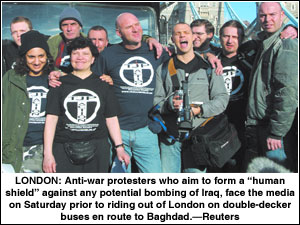
BRITISH BASE: Hundreds of anti-war protesters marched on a British military air base on Saturday to demand the right to search it for weapons of mass destruction, organizers said.
As chief UN weapons inspector Hans Blix prepares to deliver his report Monday on the search for alleged weapons of mass destruction in Iraq, international students joined local peace campaigners in a march on RAF (Royal Air Force) St Athan, near Barry, south Wales.
The protesters, calling themselves the International Citizens Weapons Inspectorate, demanded to search the site in what they described as “a non-violent symbolic action”.
International students from the nearby Atlantic college dressed in their countries’ national costume or as weapons inspectors, organisers of the march said.
“It has been a great success. The only problem was that they did not let us in to the base,” said protester Joel Kenrick.
“We handed in a petition instead. There were more than 200 people here and it was all very good natured.”—Reuters / AFP



























