0
0

ISLAMABAD, Jan 20: A senior IMF official said here on Monday that an attack on Iraq by the US-led forces would have a negative economic impact on Pakistan and the region including further increase in oil prices.
“I must say that the outcome of war will have serious consequences,” said George T. Abed IMF Director for Middle East, North Africa and Pakistan.
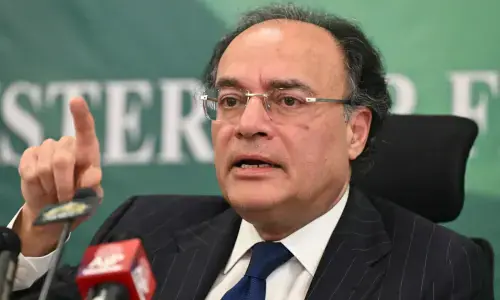
Addressing a joint news conference with Prime Minister’s Advisor on Finance Shaukat Aziz, the IMF director, who is Palestinian Jordanian, said that attack on Iraq will lead to higher oil prices, hamper Foreign Direct Investment (FDI) and discourage tourists to visit the region.
The IMF official called for reducing budget deficit to a sustainable level to avoid new problems. “We hope that current 4.6 per cent GDP fiscal deficit (Rs189.4 billion) will be considerably reduced in the next financial year,” he said. The government, he pointed out, was also likely to achieve 4.5 per cent GDP growth rate during 2002-03.
He believed that the government will achieve six per cent GDP rate during the next two to three years because of staying the course and implementing structural reform agenda undertaken three years ago.
The next mission of the IMF, he said, will visit Pakistan in March to review the economy. Another senior IMF Director Klaus Enders later told reporters that the next tranche of $109 million will be disbursed to Pakistan in February next, out of $1.3 billion Poverty Reduction Growth Facility (PRGF).
Responding to a question Abed said that the IMF was not against extending targeted relief to the masses. In this regard, he hoped that Rs5 billion new prime minister’s Falahi programme will cover the poorest of the poor.
He also did not believe that the decision to offer two per cent increased rate of profit to the pensioners will lead to any serious financial problem for the Directorate of National Savings. However, he expected the government will make sure to have early reorganization of the directorate.
The senior IMF official said that the country’s foreign exchange reserves which stood at $600 million three years ago had been enhanced to $9 billion and were now sufficient for right months of imports.
Now when the world’s economy has stagnated, Pakistan’s likely 4.5 per cent growth rate in 2002-2003 is amazing and good for the economy, he added.
However, he expressed hopes that structural reforms will continue including deregulation and the privatization of the state sector. “Major sectors of the economy have to be liberalized”, he said adding that the IMF will welcome government’s plan to offer dollar financing for machinery imports and new housing financing for the private sector.
“We have begun to think that the expected over six per cent growth in the next few years will increase per capita income in Pakistan.
Abed said that the Fund authorities also hoped that the government will maintain financial discipline so that the fruits of reforms could reach to a common man.
Asked about his concerns, the IMF official said that the government was still facing some problems in the power sector and, “I believe Wapda and KESC will be privatized as early as possible.”
He was asked that now that Pakistan’s reserves have reached to over $9 billion, why shouldn’t the ongoing PRGF agreement with the IMF not be cancelled. “No doubt Pakistan has improved its access in the international financial market and we in the IMF will continue to support Pakistan as long as we are asked for it,” he said.
He, however, added that even if there was no new programme, IMF could still offer technical support on major economic and financial matters.
The advisor on finance at this stage interrupted and said that without the IMF support, Pakistan could not have secured the historic $12.5 billion debt re-profiling from the Paris Club. “IMF is our major supporter and we value that,” Aziz said.
To a question he said that oil prices were reviewed every fortnight by an oil advisory committee in the private sector and the government has nothing to do with it.
He expressed the hope that the OPEC’s decision to produce additional two billion barrels of oil per day, will help stabilize the prices in case of attack on Iraq by the US-led forces.