0
0

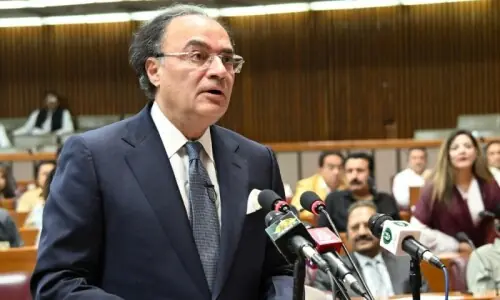
ISLAMABAD, Jan 13: Prime Minister’s Adviser on Finance Shaukat Aziz on Monday unfolded a new five-year economic vision that seeks to further improve the economy and achieve 6 per cent GDP growth by 2004.
“The current financial year is likely to end up with over 4.5 per cent GDP growth and we are projecting to have 6 per cent sustained growth within two years time,” he added.
Inaugurating the 18th Annual General Meeting of the Pakistan Society of Development Economists (PSDP), organized by Pakistan Institute of Development Economists (PIDE) he, however, pointed out, political stability, regional stability and better law and order situation were the pre-requisites to achieve the five-year vision of the government. “We must continue to remain fiscally responsible”, he said adding that continuation of consistent and transparent economic policies and completion of the structural reform programme were also the prerequisites to achieve further improvement in the economy.
Giving the details, he said that rising per capita income by 42 per cent and reducing poverty from the current level of about 30 per cent to 22.5 per cent were also the important elements of five-year vision.
The investment, he pointed out, has been planned to rise to 18 per cent from the current level of 16 per cent of GDP and saving rate to rise to 16.6 per cent from the current level of 15 per cent. “Then the inflation is to remain below 5 per cent while fiscal deficit is expected to decline from the current financial year target of 4.4 per cent to less than 3 per cent in next five years time.”
Similarly, he said that public debt would be brought down to 76 per cent of GDP in 5 years from the current level of about 97 per cent. Current account deficit to range between 1 per cent to 1.5 per cent of GDP during the next five years and the development spending to rise about 4.5 per cent of GDP from the current level of 3.3 per cent. “Social sector development will continue to be the cornerstone of the government’s economic stability,” he assured.
The focus of the five-year vision, he said, was to improve the life of common man and create employment opportunities through higher investment and growth.
“But we need patience as things don’t improve overnight,” he said adding that after three years of hard work, the country’s economic situation has stabilised. “Our economy has reached to a point of take-off. We are witnessing the signs of take-off,” he claimed.
The performance of the key indicators, Aziz pointed out, is highly encouraging as the exports during the first six months of 2002-2003 are up by 16.6pc, imports are up by 18.7pc, and most importantly non-food and non-oil imports are up by 22pc and machinery imports are up by 34 per cent.
“This is a clear reflection of growing economic activity in the country and this can be ascertained by the facts that tax collection is up by 15 per cent and most importantly, sales tax from domestic activity is up by more than 41.4 per cent.”
Inflation, the advisor on finance said, continues to remain below 4 per cent during the first half of 2002-2003, while remittances were close to $1.8 billion and foreign investment was $474 million during the first five months of the current fiscal year. “Our foreign exchange reserves stood at $9.3 billion on December 31, 2002. We have added $3.1 billion in our reserves during the first half of 2002-2003,” he said. Reserves, he said, were likely to cross $10 billion even before the end of current financial year.
He also apprehended oil shortages in case the United States launches any attack on Iraq. “There is a general perception that an armed conflict in Iraq would thoroughly shake the already fragile economy, causing disruption in oil supplies to the rest of the world, particularly Asia which has little oil reserves of its own and remains heavily dependent on imports”, he said.
“Such a disruption is bound to cause oil price hike, rising economic uncertainty, and decrease in business and consumer confidence,” he further stated.
Aziz said that Pakistan would have to face problems in importing its oil supplies, had the Bush Administration decided to attack Iraq.
A recent estimates suggested that a sustained price-hike of five dollars per barrel of crude would slow down growth in world economy by 0.3 percentage point with Euro zone and the United States witnessing drop in GDP growth by 0.4 percentage point.” To the extent Pakistan is integrated with the world economy, the slow-down is likely to cause temporary difficulties to us as well,” he conceded.
The avoidance of war in Iraq, therefore, was in the best interest of the global economy in general and developing countries in particular, he added.
“We have achieved a modicum of stability. Fiscal deficit which averaged 7 per cent of GDP in 1990s, has been reduced to 5.1 per cent last year and is projected to decline further to 4.4 per cent in the current financial year,” he said.
The current account deficit which averaged almost 5pc of GDP in th 1990s, has turned surplus to the extent of 2.1pc last year and the surplus is likely to be even higher this year. “As a result of the significant improvement in the twin deficits (fiscal and current accounts deficit), our debt situation has also improved considerably,” he said.
The domestic debt, Aziz continued, which was increasing at an average rate of 16 per cent per annum during 1990-99, declined in fact by 2.5 per cent last year. “It is projected to decline further this year,” he said adding that external debt and foreign exchange liabilities which stood at $38 billion or 335 per cent of foreign exchange earnings have declined to about $36 billion or 233 per cent of foreign exchange earning last year.
Aziz said that despite a series of domestic and external shocks such as unprecedented drought, the event of September 11, and the military build-up of India, the economy is now more stable, economic policies are transparent and predictable and the confidence of the private sector is restored, he said. He said that overseas Pakistanis were bringing their capital back and the stock market is buoyant and external balance of payment are in comfortable position.
Improvements in Pakistan’s economic fundamentals have had their impact on the Karachi Stock Exchange (KSE). “You would happy to know that KSE has witnessed a phenomenal growth in the year 2002 and was regarded as the best performing market in the World,” Aziz said.
Share index and market capitalization has more than doubled in 2002. The month wise turnover of shares jumped from 907 million in December 2001 to 6.73 billion in December 2002 thus recording a phenomenal growth of 642 per cent. The rising trend in share index, he said, continued during the month of January and market closed at 2869 points on January 11. “Hopefully by the end of this month the market may breach the index level of 3000 points,” Aziz predicted.