



 0
0

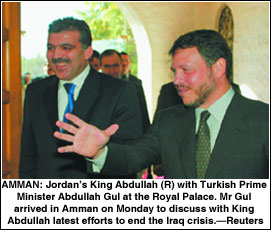 AMMAN, Jan 6: Turkish Prime Minister Abdullah Gul and Jordanian leaders voiced concern on Monday that a US-led invasion of Iraq could destabilize their own countries and sought ways of averting a strike.
Gul met Jordan’s King Abdullah and Prime Minister Ali Abu Ragheb on the third leg of an Arab tour, during which they also insisted on the territorial integrity of Baghdad and warned that an attack would be detrimental to the region’s welfare.
“A military operation will have very important negative effects for the security and the stability of the region, both on the economic and political levels,” Jordan’s Petra news agency quoted Gul and Abu Ragheb as saying.
Abu Ragheb also agreed with Gul that Iraq’s “sovereignty and territorial integrity” must be respected at all costs, and reiterated Jordan’s refusal to be a launchpad for a military strike on Baghdad, Petra said.
Cash-strapped Jordan depends on Iraq for all its oil needs and Baghdad is its top export market.
A Turkish embassy statement earlier set the tone, saying: “Turkey and Jordan shall be the two countries, besides Iraq, most adversely affected in case of war against Iraq” — echoing the concerns of top Jordanian officials.
King Abdullah insisted on a speedy solution to avert war against Baghdad, saying a settlement must be found through the United Nations and stressing Iraq must not be broken up.
For his part Gul told a press conference that everyone in the region “is in a very delicate position”.
“We are very worried by what could happen in the aftermath of an eventual war,” he said through an interpreter.
“All our efforts are being made to achieve peace and prevent a war from erupting in the region whose repercussion would be very dramatic,” Gul said after emerging from talks with King Abdullah.
Gul said he agreed in discussions in Syria, Egypt and Jordan over the past three days with the leaders of those countries “to consolidate our efforts all together”.
“We are very much satisfied by these discussions,” during which he said “steps”, which he did not identify, were taken.
He added that he looked forward to a “very fruitful” visit in Saudi Arabia on Jan 11, which will be also devoted to Iraq.
Gul, who met on Saturday Syrian President Bashar al-Assad and Egyptian President Hosni Mubarak on Sunday, insisted that Iraq’s sovereignty should not be harmed.
“The official policy of the Turkish republic is to preserve the unity of Iraq’s territory and that the entire Iraqi people benefit from the riches of Iraq,” he said.
This was in a clear reference to Turkey’s opposition to any US-led action that would lead to the breakup of Iraq.
Turkey, a key NATO ally of the United States and the only Muslim member of the North Atlantic alliance, has come under increasing US pressure to throw its weight behind Washington’s plans for a possible invasion.
But it is afraid that a conflict will lead to independence for Iraq’s Kurds, stirring separate ambitions among Turkey’s one substantial Kurdish minority.
Gul likewise reiterated that his discussions in Syria, Egypt and Jordan did not broach US suggestions of a regime change in Iraq or the possibility of exiling Iraqi leader Saddam Hussein.
“We did not discuss the topic of exile for Saddam Hussein. We discussed how to reach a solution and avoid a war,” he said.
Likewise he stressed that any decision to agree to allow US forces to deploy in Turkey would be taken by parliament.
“Receiving foreign soldiers or sending Turkish soldiers outside (the country) can only be decided by the parliament,” Gul said.
numerical supremacy: The US military is assembling a ground force for a possible invasion of Iraq that could exceed 100,000 troops, the Washington Post said on Monday, quoting defence officials and analysts.
US ground forces would have enormous advantages in technology, firepower and mobility, with air supremacy, according to defence officials and analysts. But Pentagon officials are also putting an emphasis on achieving numerical supremacy.—Reuters


























