0
0

 KARACHI, Jan 3: Anjuman Taraqqi-i-Urdu, celebrating its centenary, has stressed on the promotion of Urdu as the official language of the country saying that it had been contributing greatly to the national cohesion.
A series of events have been organized by the Anjuman jointly with the Aligarh Muslim University Old Boys Association (AMUOBA) and Sir Syed University of Engineering and Technology (SSUET).
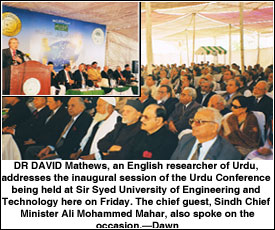
The inauguration ceremony, titled ‘international debate’ was the first event of the series held at the SSUET premises here on Friday. Chief Minister Ali Muhammad Mahar was the chief guest and a large number of writers, poets, critics and scholars attended the function. The next event, International Urdu Conference, has been scheduled for Saturday on the same premises.
Speakers on the occasion maintained that Urdu was a language acceptable to the people of all provinces and that it could play a more effective role in the unity and integrity of the country. They emphasized the need for effective measures by the government for the enforcement of Urdu as the official language.
In his address, Mr Mahar highlighted and commended the role of Anjuman Taraqqi-i-Urdu, ever since its inception in 1903, in the evolution and promotion of Urdu before and after the partition.
Recounting the history, the chief minister said that Urdu was born in Sindh with the emergence of Muslims. He contended that being the medium of person-to-person communication between the people of Sindh and those speaking Arabic, Persian, Turkish, etc. Urdu evolved as a language.
Gradually, he added, Urdu strengthened its roots, first in the whole of Sindh and then across the subcontinent. Referring to the blending factor, Mr Mahar pointed out that there were hundreds of Urdu words which could now be found in Sindhi literature. He said Urdu and Sindhi never clashed as both the languages were flourishing in the same cultural and literary environment.
The CM indicated that the Constitution recognized Urdu as the national language of the country and as such it was the duty of the whole nation to ensure its promotion. He, however, clarified that promotion of Urdu did not mean leaving behind other languages of the country.
Presenting his votes of thanks, the honorary secretary of the Anjuman, Jamiluddin Aali, said that seminars, symposia and many other programmes were being organized throughout the country to celebrate the centenary event.
Referring to the slackness on the part of successive governments in implementing Urdu as official language, he urged the present government to take appropriate measures to fulfil this constitutional obligation by the year 2005.
The Chancellor of the SSUET, Z. A. Nizami, who is also President of the AMUOBA, said in his speech that Sir Syed Ahmed Khan was the first person who demanded the rulers in 1867 to establish an Urdu university. He welcomed the establishment of Federal Urdu Arts, Science and Technology University now when the Ajuman was celebrating its centenary.
He announced that Urdu was being implemented as compulsory subject at the SSUET from Jan 6 whereas the work on Urdu software would also be started soon.
David Mathews, a renowned Urdu researcher and teacher at London University, pointed out that historically Urdu, along with Hindi, was a popular language in the region. Even today, he added, it appeared to be the easiest medium of communication in Pakistan. He remarked that Urdu had, no doubt, a safe future and that it would develop further.
Mr Mathews indicated that Urdu enjoyed the status of fifth major language in England’s South Asia department.
The chief minister of Punjab, in his message read out on the occasion, said: “as a follower of Quaid-i-Azam, I will take all measures to accord Urdu its due status in the province as it is the national language of this country.” Several other messages, including one from Zubeda Jalal, the Federal Education Minister, were read out during the ceremony whereas one of the messages, written by Sir Syed Ahmed Khan, was selected to be read on this occasion.
The president of the Centenary Celebration Committee, General (r) Ghulam Umer, General secretary, Mazhar Arif and President of Anjuman Taraqqi-i-Urdu, Aftab Ahmad Khan, also spoke on the occasion.