0
0

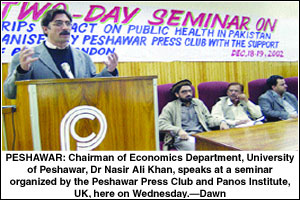 PESHAWAR, Dec 18: Speakers at a seminar here on Wednesday urged the public and private sectors to get prepared for the challenges posed to the country’s food and public health sectors at the hands of Trade Related Aspects of Intellectual Property Rights (TRIPs).
“The world population would increase from 6 billion to 8.5 billion in 2050 and Pakistan would become the fourth largest country. The demand for food would also rise and for this we have to increase the size of cultivable land from 20 million hectares to 30 million to feed our people,” said Dr Nasir Ali Khan.
Making a presentation on TRIPs and World Trade Organization at the opening session of the two-day seminar titled “TRIPs impact on public health in Pakistan,” organized by the Peshawar Press Club, he said the world had become a global village due to the progress in information technology and countries had become dependent on each other in the fast emerging trade scenario.
He said there was a dire need on the part of all the 144-member countries of the WTO — including over 100 developing countries — to develop technology and necessary know-how and adopt transparent trade and manufacturing policies for their economic growth and development.
This, he said would automatically lead to the establishment of peace, as most of the conflicts were rooted in trade.
However, he said, the WTO dictates regarding free trade may result in more profit for the commercial concerns, which could also cause unemployment and degradation in public health and environment. Small countries, he said, would be at the receiving end, because of their inability to compete in research and development and the US and European countries would rule the world as usual.
He also suggested formation of a trade bloc comprising Saarc countries on the pattern of EU and Asean to get prepared for the implementation of the WTO regulations in 2005.
General Manager of Smeda, Sultan Tiwana, was of the view that there was nothing to fear and said that the relevant laws which would come into force with the introduction of WTO, would protect the business secrets.
He said that conventions had been taken place in Paris, Bonn and Rome since the debate on the WTO had started where all the countries had been told about the regulations.
Mr Tiwana said that Pakistan had to adopt the WTO rules and interact with other countries, otherwise the world community would not trade with it. Foreign direct investment would not come in the absence of the rules and regulations of the WTO.
Former president of the Sarhad Chamber of Commerce and Industry, Jamshed Sawal, in his paper said that the government had already undertaken preliminary work for the WTO by establishing a Patent Cell at the Ministry of Commerce and promulgated five ordinances in this regard.
He said Pakistan was the fourth largest producer of cotton, but three per cent of its cotton got contaminated due to lack of facilities to protect it. After the implementation of WTO regulations growers would be able to hire experts from other countries to produce quality cotton and compete in the international market.