



 0
0

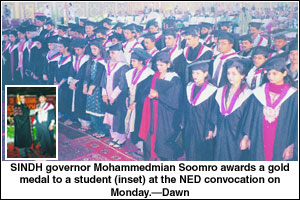 KARACHI, Dec 16: The government can frame a fresh policy for appointment of chairmen of educational boards in the province, instead of going through nominations, Sindh Governor Mohammedmian Soomro said on Monday.
The government, he added, would do away with the present system of appointing chairmen through nominations and could fill the vacancies through open competition — a policy that has already been ordered for appointment of chairman of the Sindh Board of Technical Education — under which appointment should be made through the Sindh Public Service Commission.
He was talking to newsmen after the convocation ceremony at the NED University. The attention of the governor, who is also the controlling authority of the educational boards, was drawn towards the reaction of teachers and other concerned over the recent appointment of educational boards’ chairmen, including the Board of Secondary Education, Karachi.
To a question, he said that the recent appointments of retired officials, including a retired army officer, might be reviewed. He said that experience of appointees in the administration was kept in view while appointing them, but their cases could be examined again if they did not fulfil the required qualifications.
He said that search for a suitable person for appointment as chairman of the technical board was also in process. He said that he had received the report on Sept 7 incident on the KU campus and action would be taken soon in the light of the report.
To another question, he said that the government was also taking measures for strict adherence to merit policy regarding admissions in medical colleges. Necessary investigations and legalities were also under consideration to hold the persons responsible for alleged violation of rules and for allowing illegal admissions in the Sindh Medical College, he said, adding that action against those responsible had been delayed because the government wanted firm evidence before taking any action.
To another question, he said that the model university ordinance would be implemented in phases and at present it was not applicable in the case of universities given charter by the provincial government. He said the ordinance was formulated after detailed research and consultations with all the stakeholders, but even then if some quarters had reservations on it they would be listen to, and changes could be made to the law accordingly, if needed.
EDUCATIONAL BOARDS: Meanwhile, the two newly- appointed chairmen of the Board of Secondary Education and the Board of Intermediate Education, Karachi, took charge of their offices on Monday. The handing- and taking-over of charges were witnessed peacefully at the two boards, claimed official sources.
Mohammad Shafiullah Qureshi, a retired brigadier, took over the charge of chairman of the Board of Secondary Education for three years. Talking to newsmen at his office, he said that he was unaware of the fact that the government wanted to appoint him as chairman of the board.
He said he had served for about 32 years in the army and also had joined a blood transfusion organization after retirement in the administration side. Hailing from Hyderabad Deccan, he completed his MSC in war studies and was commissioned in the army in 1968.
Referring to the reaction by teachers, which continued even on Monday morning, he said that he believed that the teachers would continue their traditional support to the board and not put educational career of students at stake. “Any boycott of examination works by them will surely cause losses to students and thus the teachers should not adopt such an approach,” he maintained.
On the other hand, Prof Iftikhar H. Zaidi, took the charge of the chairman from Dr Mohammad Sharif Memon at the Board of Intermediate Education.
Mr Zaidi, who was serving as director of colleges, while speaking to the staff of the board at a ceremony, said that he wanted to run the affairs of the board in a cordial atmosphere. All good measures, including the compulsory 75 attendance rule, would continue while efforts would also be made to improve the financial position of the board, he said, adding that “we must discharge our duties honestly and work for the betterment of educational environment in the city.”




























