



 0
0

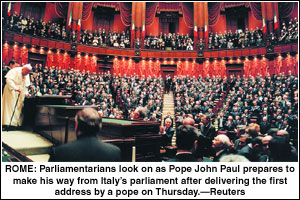 ROME, Nov 14: It was one small step for Pope John Paul and one giant leap for the papacy.
For the first time, a Pope on Thursday addressed Italy’s parliament, a visit laden with historical meaning for the Vatican’s relations with Italy.
In his landmark address to a joint session, the 82-year-old Pope spoke of burning problems facing the country, much of which was ruled by his predecessors until Italy’s unification in 1870.
Speaking in a strong voice, he urged Italians to have more children in order to turn around one of the world’s lowest birth rates.
He mentioned the plight of the unemployed, decried what he saw as moral decay fed by the media, and called for reductions of sentences to deal with a population explosion in prisons.
The Pope also appealed to Europe to maintain its Christian roots as it embarks on an enlargement process that will include his native Poland.
Italian media covered the event almost as if it were a trip to the moon, with newspapers devoting pages to the occasion and state television tearing up its normal programming to broadcast the visit live.
Helicopter-borne cameras followed the papal motorcade for the short route between the Vatican and the lower house of parliament, and deputies gave the Pope a two-minute standing ovation as he entered the chamber.
Until the mid 19th century, the Catholic Church ruled a large swathe of central Italy. The Papal States were lost in 1860 and the papacy had to give up Rome 10 years later when troops of King Victor Emmanuel moved into the capital.
Popes considered themselves “prisoners of the Vatican” until 1929 when the 44 hectares of Vatican City, the only territory that remained of the Papal States, became a sovereign city-state.
The fact that more than 130 years had to pass before a Pope could address parliament underlined the fact that many Italians still view the Church’s influence on their lives with suspicion.
Speaking in the building that housed the papacy’s law courts until the mid 19th century, the Polish Pope offered Italians a catalogue of the problems of today’s society.—Reuters



























