



 0
0

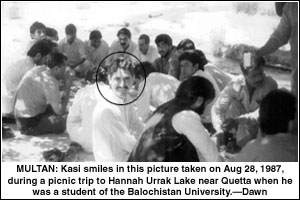 MULTAN, Nov 13: While the execution of Mir Aimal Kasi is scheduled to take place in Virginia, US, on Thursday (today), questions like why he gunned down two CIA officials and who were the recipients of $3.5m reward for handing him over to the American authorities remain unanswered.
Mr Kasi, 38, was accused of killing two CIA officials and injuring some others on Jan 25, 1993, at the parking lot of the US premier intelligence agency in Langley, Virginia. After the incident, he flew back to Pakistan where he remained in hiding for over four years before a team of American and Pakistani officials raided a Dera Ghazi Khan hotel to ‘arrest’ him on June 15, 1997.
He had been staying in the hotel since June 13 under the fake identity of Saifullah Khan hailing from South Waziristan. He was reportedly expecting a guest about whom he had informed the hotel receptionist. However, he was deceived and whisked away to the gallows in America.
A few dozen heavily armed personnel, several vehicles and a C-141 plane took part in the bloodless ‘Get Kasi’ operation. Though at one stage there arose a possibility of a shootout between local police and the personnel involved in the operation when a police mobile started chasing the convoy of the vehicles. The encounter was averted when some ‘superior’ awakened the then acting police chief of Dera Ghazi Khan, Dr Jameel, from his pre-dawn sleep by telephone to stop his ‘stupid’ subordinates from creating hurdles in a ‘top secret state mission’.
In the following couple of days, people and newspapers of Dera Ghazi Khan kept on guessing about the person ‘kidnapped’ from the hotel while the police and civil administration were keeping mum over the issue. The maximum they could offer in response to newsmen’s queries was that “it was an official mission carried out by commandos”. At least, the Dera Ghazi Khan police did not know what happened.
Four days after the operation, a C-141 plane landed in America carrying Aimal Kasi, one of the FBI’s 10 most wanted fugitives. Initially, the authorities in America and Pakistan denied that it was Kasi who had been whisked away from the Dera Ghazi Khan hotel. However, the US authorities soon gave up on this front to start a debate on the area where Kasi was ‘arrested’.
However, the Pakistani authorities kept on denying that Kasi was whisked away from Dera Ghazi Khan or any such area in the country which was ruled by the law. Otherwise, they would have to admit that legal procedure was not followed while ‘extraditing’ Kasi. The country was then under democratic rule. The rulers came under criticism from various corners including civil society organizations and religio-political parties. The pressure compelled the government not to admit that Kasi was sent away from an area governed by the law of the land.
Kasi’s kidnapping drew more public outrage as compared to the extradition of Yousaf Ramzi, because he was a bonafide citizen of Pakistan. The Amnesty International has recently declared Kasi’s sentence illegal because ‘a hostage can not be prosecuted and sentenced’. However, Kasi’s kidnapping was just a curtain raiser on a series of events that unfolded in Pakistan after Sept 11.
Whereas the American and Pakistani personnel have joined hands for a ‘global war on terror’, once decorated and eminent Pakistani citizens are being grilled for alleged links with anti-American Islamists.
This is being termed a consequence of the so-called U-turn in country’s foreign policy. Irrespective of Sept 11, the main principle of the foreign policy is to succumb to the American pressure whether it is the case of Kasi or that of nuclear scientist Sultan Basheeruddin Mahmood or that of Dr Amer Aziz.
US authorities often claim that Kasi had killed CIA men to avenge their anti-Muslim polices. However, this is just a cover to hide the truth. Nobody has been able to link Kasi with any militant organization. A peep into Kasi’s past and interviews with his friends and relatives dispute the US media’s claims about his religio-extremist tendencies.
He was an urbanite who after doing masters in English Literature from the Balochistan University wanted to live in America or Europe. Prior to his departure to the US, he reportedly worked ‘closely’ with an American-aid programme for the Afghan refugees in Quetta. He managed to get the American visa without appearing before the immigration authorities.
Kasi’s friends of his days in hiding also do not suggest that he harboured bloodthirsty tendencies against common Americans or that he was a religious man. Saying five prayers a day by a Pashtoon does not necessarily reflect that the man is an extremist. However, there are reports that he met Osama bin Laden and Taliban chief Mullah Umer during his days in hiding. However, there is no report that he had ever been involved in arms-trafficking or any such trade assumed to be part of a militant’s life.
Instead, he ran a filling station in Balochistan. A younger brother of a senior bureaucrat of Balochistan, who belonged to the nomadic Pashtoon Nasir clan, was his partner. He also did business with another Nasir clan man who provided him shelter with a Khosa tribe elder in the riverine belt of Dera Ghazi Khan in Shah Sadar Din area.
This Nasir clan man was in the VIP room of the hotel when Aimal Kasi was whisked away by a team of American and Pakistani officials. In a letter to his Khosa tribe host, written from the Fairfax county prison of Virginia, Kasi pointed out that the man who had brought him for shelter was among the people who trapped him in the hotel.
Among others, a senior bureaucrat belonging to Nasir clan, a Jaffar tribe bureaucrat, a bureaucrat who was a close relative of Kasi and an official of the Quetta’s commissioner office were reportedly among the recipients of the headmoney on Kasi besides an influential member of the Leghari tribe.
The Legharis have always denied any role in the ‘Kasi saga’ but incidentally all bounty-hunters are linked to the clan. But the unscheduled visit of the then president Sardar Farooq Leghari to the area on June 14, 1997, also gave weight to the speculations of his family’s involvement is the trap for Kasi.




























