0
0

 KARACHI, Nov 11: If you were a foreigner visiting this city, and you happened to move about too, many thoughts would cross your mind. At times you’ll wonder whether or not the country had got independence only recently. After all, the people seem to be trying their best to catch up with the rest of the world.
At other times you’ll be wondering whether or not Pakistan was in the middle of a “boom” of some kind, may be something similar to the famous Middle Eastern oil boom of the ‘70s. The reason: the almost simultaneous undertaking of construction work on at least six busy thoroughfares of the city.
You would get an impression from this seemingly sudden burst of developmental activity, that the authorities were in a hurry to solve the people’s problems. Why else would they take in hand, almost simultaneously, so many development projects?
One of the projects undertaken involves the laying of a pipeline on Jahangir Road. Work on this project began about a month ago. This project is particularly worrisome for the motorists because Jahangir Road is a particularly busy thoroughfare.
The second project is the one on the Business Recorder Road in which a pipeline has been laid. Work on this project is almost complete but re-carpeting of the road has been pending for the last several weeks, causing innumerable problems to the motorists.
The third project is the one on the road that runs between Abdullah Girls’ College and Banaras Chowk. Work on this project has been going on for the last ten months but only less than half of it is complete.
The fourth project is the one on Rashid Minhas Road, under which re-laying and re-carpeting work is to be done. Incidentally, work on this project may be discontinued, owing to a dispute between the contractor and the city government.
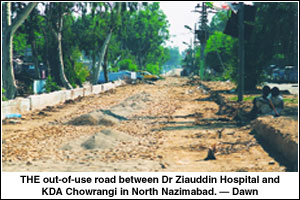
Yet another project involves the thoroughfare running between Dr Ziauddin Hospital and KDA Chowrangi, North Nazimabad. A new pipeline has already been laid but re-carpeting and finishing work is pending. The sixth project is on some parts of Shahrah-i- Orangi, construction work on which began more than two years ago.
Meanwhile, if you were a foreigner and you stayed in Karachi long enough, you’d realize that the authorities in the developing countries, especially Pakistan, were never in a hurry. And that the authorities here in Karachi were even less pushed than the ones in the other cities of the country. So, work had been undertaken on the six projects almost simultaneously purely by default, and not by design.
Therefore, in the next two or three months, not much progress is likely vis-a-vis the eight road projects. (We are in the middle of a Ramazan, remember?)
On closer examination, you will notice that the authorities here behave quite differently than the ones in the developed countries. For instance, they don’t waste time in providing proper, and adequate, alternative routes. They, no doubt, think that Karachiites are intelligent people who could take good care of themselves.
Similarly, they don’t spend much time in letting the citizens know beforehand, through the newspapers or television, that certain roads are going to be dug up almost simultaneously. Karachi is full of fit people who will survive come what may, they no doubt feel.
The authorities don’t have much regard for safety considerations.
That’s why you see great bulldozers and other earth-moving equipment in nonstop operation, sometimes in the middle of the road, as cars and other vehicles whiz past them nonchalantly. Bravery and courage, after all, must be appreciated, not frowned upon.
The citizens of Karachi, in the meantime, will come across as an extremely patient and understanding people. You will see them silently endure months, even years, of wait before they will reclaim the use of roads which often took them directly, and speedily, to their destinations.
In the intervening period, these souls will negotiate potholes and ditches on what can only be called dirt roads which they are forced to use but which are never officially designated as “alternate routes”. (Designating these roads as “alternate routes” is perhaps viewed as an intrusion into a citizen’s affairs.)
If you asked a government official why the development projects hardly ever ended by their deadlines, you will come to know that all such projects suffered from fits-and-starts funding. Under this kind of funding, only a small fraction of the total layout is released initially.
So, for instance, only Rs2million will initially be released in case of a Rs50million project. Only after the work on this phase is completed, and inspections undertaken that okay this work — can additional funding be provided. This kind of funding is time consuming but extremely efficient, you will be told.
If you turned to the issue of prior planning, you will be told that, as far as this part of the world is concerned, such a thing will remain a pipedream for years to come. “How can you plan when you know that each and every project is going to extend beyond its deadline,” you will be told.
“How can you plan when the only certain thing is uncertainty itself.” Defending the authorities, the official will tell you that the projects under discussion were all forward looking ones. “The Karachiites’ lives will improve once these projects are completed, I can assure you.”
He will ask you to be considerate. “Look, we are damned when we don’t. That is, if we don’t undertake projects. And we are damned when we do. That’s not fair.”
In the end, you will conclude that the situation is not likely to change anytime soon. At least not if there’s no drastic change in the way the city approaches construction or development work.