0
0

Pakistan has been steadily building up its reserves over the past couple of years. A steep rise was witnessed soon after the September 11 incidence in the United States. The flow of remittances from overseas has increased substantially over the past year.
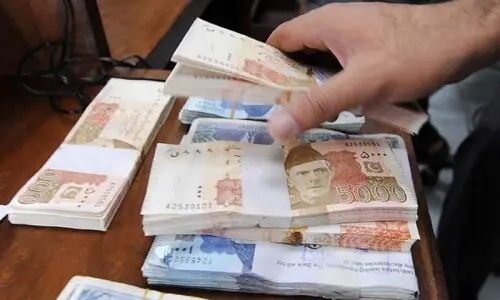
The reserves have risen from an all times low of under $500 million during the later part of last civilian government of Nawaz Sharif to an all time high of $8.3 billion. While the minister of finance tries to take all credit for the rise in reserves, the fact of the matter is that these reserves are largely made up of dollar purchases by the State Bank of Pakistan from the open market.
The bank spent close to Rs100 billion to buy nearly $3 billion over the past two years. Almost similar amounts were remitted home by the Pakistanis working abroad. As the industry has been almost at a standstill there has also been drop in imports of plant and machinery thus saving another few millions for the reserves.
Massive buying of dollars by the SBP from the open market has influenced the market value of dollar in a big way. The dollar was being traded between Rs67 to Rs69 just before September 11, 2001. Then a sudden surge brought millions to Pakistan and the price of dollar came down to around Rs60 within a very short period.
The buying of large amounts of dollars by the State Bank from the open market has kept the dollar rate high. It has been hovering just over Rs60 for the last eight months. Faced with the criticism by experts, in August 2002, the bank stopped briefly from protecting the dollar from downward slide. The result was that the dollar came down nearly one rupee within a short span of ten days.
The dollar, if left to float to its natural level could come down to Rs55 or even Rs50 within three months making a saving on foreign loan of Rs180 to Rs360 billion. This is a massive sum when one considers that total taxes collected in any given year have yet to touch Rs400 billion. It is indeed a sad reflection on the wisdom of those who are running the economic affairs of the country that the State Bank went back to the market for buying dollars and it has been reported that during the first three working days of September 2002 it purchased some $12-14 million from the market. It is evident from recent market response that dollar is spiralling downwards. It has gone down to under Rs59 to a dollar of late. The SBP had better let it find its natural level. It is indeed in the larger interest of Pakistan.
Supporting dollar in a country like Pakistan is simply strange by any stretch of imagination for here is a country indebted in foreign exchange to the tune of $36 billion and a drop of just one rupee in the price of dollar means a saving for the nation of no less than Rs37 billion. The excuse the State Bank has been giving for intervening in the foreign exchange market to support the dollar is that it helps our exports as weaker rupee attracts more overseas buyers.
This has, however, been proved wrong time and again. Using similar means in the past have proved fatal and the rupee has been sliding downwards unabated with little or no improvements in exports. What the big wigs of economic echelons of Islamabad have been ignoring all along is the fact that the country is net importer of foreign goods and it has amassed foreign debt of over $37 billion.
Currently we are repaying this debt at the rate of approximately $6 billion per annum and our imports are higher to the tune of $2-2.5 billion compared to exports. We should, therefore, be looking for a weaker dollar so that we have to find fewer rupees-to pay for both imports and instalments of our debts. This would inevitably mean fewer taxes, leaving larger disposable income in the hands of people of Pakistan. When people have surplus disposable money the economic circle comes into swing. It leads to spending, manufacturing, job creation and prosperity.
It is unfortunate that time and again IMF/World Bank trained ‘experts’ or ex-employees of American banks are given the task of running the affairs of our economy. They are trained to look after the interests of the organizations they have worked for. Their heads are buried in the sand castles of multinationalism and globalization. It is perhaps too much to expect from them to be patriotic for they must be keeping an eye on the desks that they would return to once someone else, of similar ilk, replaces them in Islamabad or Karachi.
There is of course another angle to it. Not long ago we were so short of foreign exchange that we were told that we shall have to dispose-off some of our national assets to reduce the burden of cumbersome foreign loans. At one time it was stated by the Privatization Commission (PC) that it expected to collect some $4 billion from the sale of nearly all our major national assets.
That seemed fait accompli given that the lenders were breathing down our necks and we had little or no reserves to live on. One thing lead to another. More loans were given to repay existing loans. Some were later rescheduled and we lived by. That state has fortunately come to pass. Pakistan is now in a comfortable position in so far as foreign reserves are concerned.
It is all the more strange under the circumstances to hear of speedy privatization of all the main assets of the nation. The PC aims to sell as far as your imagination can take you. The Oil and Gas Exploration Company (OGDC), the Pakistan State Oil (PSO), the Pakistan Telecom (PTCL), National Investment Trust (NIT), the Pakistan International Airlines (PIA), the Habib Bank, the United Bank, Wapda, the KESC, fertilizer companies, cement factories, the Pakistan Railways, gas distribution companies, to name but a few, are the enterprises the government considers a burden and wants to get rid off. The likely buyers are to be foreigners as Pakistani entrepreneurs have been squeezed to the pip.
Looking at just some of these enterprises one fails to understand the logic behind such a move. The PC hopes to get some $1 billion by selling 49 per cent shares of the OGDC. This Company has proved to be very successful. It owns very expensive drilling equipment that can drill oil and gas from rough terrain thousands of metres deep. It made over Rs23 billion in profit last year and increased its assets by Rs9 billion during the same period. The OGDC provided 39 per cent of total oil requirement of the country making a saving of nearly one billion dollars ($946 million) in import bill. The progress of the company can be judged from the fact that In 1996-97 it provided only 11 per cent oil and saved $557 million in import bill. Any thought of disposing of such a vitally important company to some foreigners is unthinkable.
The Habib Bank operated nearly 2,000 branches up and down the country until recently. It alone had 65 branches in 26 countries in the Middle East and Europe apart from a number of liaison offices in Far East and African countries. It had 12 branches in Oman alone making it the biggest overseas bank there. It handled over one third of the total import and export trade of the country. The Habib Bank had Rs362 billion worth of assets in 1996 and deposits of Rs213.49 billion. It made a profit of Rs2.3 billion in that year.
Similarly United Bank at one time operate over 1,600 branches. Its operations extended to Qatar, Yemen, Oman, Saudi Arabia, Bahrain, UAE, UK, USA and Switzerland. It has assets of around Rs200 billion. United Bank covers some 20 per cent share of business in Pakistan. It is beyond belief that a foreign consortium bid under Rs5 billion to buy it while Pakistani banker offered to purchase it for nearly Rs12 billion.
Even though the difference was embarrassingly large the Pakistani bidder was not given the go ahead. An open bid was called for on 5th September as if to find some way of ditching the Pakistani banker and to allow some overseas buyer on board. This huge institution was sold to a UK-UAE consortium in preference to Pakistani bidder for just around $200. At,,the time of sale it still had over 1,150 branches. It may be of interest to note that throughout the past year Pakistanis living abroad have been sending over $100 million every month through United Bank alone.
The story of privatization of the National Bank of Pakistan (NBP) is also in the making. It is being slowly privatized through stock exchanges. Even though a fraction of Pakistanis invest through Lahore, Karachi and Islamabad stock exchanges, it has been considered appropriate to offer the NBP shares to public through this medium. Some unknown entities appear to be building up their stakes in the NBP quietly through this method. A more transparent way of disposing shares in the NBP should have been devised. If, for instance, application forms for shares had been made available from branches of all major banks it would have been possible to attract larger number of local investors.
Banks provide the government with important treasury support. In an emergency (like the one at the time of nuclear tests in May 1998) government can prevail upon national banks to come to its assistance. In case the banks are privatized the government will lose accessibility to billions. Any foreign owner is unlikely to be sympathetic to any of our national needs. They would impose strict conditions on any loan facility and make us pay through the nose if they feel like it.
The Pakistan State Oil (PSO) runs through Pakistan like blood runs through our veins. All our vital plants, defence needs, commercial activity owe their operations to the smooth and regular supply of oil from the PSO. It has over 4,000 outlets and was for a time listed among the world’s top 500 companies on assets basis. Obviously profitable even this-vital company (No! institution) is under the hammer of privatization. Having already allowed to build stake in the PSO some foreign competitors are already waiting in the wings to pounce.
The Pakistan Telecom (PTCL), another state owned organization, has a monopoly over our telecommunication system. It took over 50 years and billions of rupees for the PTCL to build up its network of telephone exchanges and lines. It has now connected the whole of the country. It has even captured major portion of the mobile phone market. The PTCL has been hugely profitable. It is expected to make close to a billion dollars profit in the current financial year. The PTCL is also being sold and its buyer can only be a foreigner as locals do not have the liquidity to come up with the required minimum. Even security consideration do not seem to matter in matters of privatization any more.
The National Investment Trust (NIT), like the Investment Corporation of Pakistan (ICP), has built its trust among Pakistanis, especially the elderly. It has investment in 600 out of 720 listed companies in Pakistan. It plays a major roll in their development knowing when to inject more and reap more profit for the unit holders. Any would be buyer of NIT can quietly come and join the board of directors of most of our successful companies. He may, if he wishes, withdraw his investment and let them free fall. The consequences of an engineered failure of our companies that may otherwise be successfully competing, can wreak havoc in our tiny industrialized world.
All over the world people are protesting against privatization and globalization. God only knows why our planners are dying to implement it without considering the consequences.
The euphoria of fear and distrust created mainly by the Bush administration has turned the United States and major part of Europe into a hostile environment for Muslims. This environment is likely to take a lot of healing and time to change. It is, therefore, reasonable to assume that substantial remittances would continue to boost Pakistan foreign currency reserves for a considerable time to come.
WE can therefore, afford to relax a little on that account. What is needed is a coordinated effort to give the economy a kick start with part of the reserves now available. Alas! The money that should be made available to local industry is being diverted abroad. There is talk of seeking the advice of international fund managers about the use our reserves
On the one hand we are selling our best assets to overseas buyers and in an indirect sort of way providing them with money from our own sources to pay for it. It may-just be a coincidence that just before the sale of the United Bank to UK-UAE consortium our experts had travelled to UAE seeking advice on how to invest $750 million of our foreign exchange reserve. Those who are buying our valuable assets have no magic wand. They would simply inject more funds, where needed, keep a strict control over management and end up making even bigger profits. Why can’t we do the same?