



 0
0

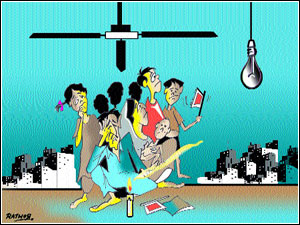 The prospect of shortage of power of 5,529 mw by the year 2009-10 unless adequate steps are taken to increase output of power correspondingly in good time will not alarm a people already suffering load-shedding or prolonged break-downs of power supply.
What has not been made clear by the Power Policy-2002 is whether the official projection of a shortage of 5,529 mw eight years from now has been made on the basis of the low level of current economic activities, with 4,000 to 5,000 industrial units reported sick, or on the expected increase in industrial production and other economic activities as a result of the current economic reforms maturing.
While the increasing shortage of power is a major problem for the power supply companies in the country, the consumer, whether industrial or domestic, is too often paralysed by the breakdown of the transmission and distribution system. Much of that is too old, as in Karachi, and often poorly maintained. Hence the agony of the consumer is compounded in what is called the electronic age.
So the hype for rapid promotion of the use of computers and internet in a country with no power in large parts and two-thirds of the people illiterate, will not produce the kind of great results promised even in the medium term.
What the projection of the eventual shortage of 5,529 mw by 2009-10 indicates is that unless the government swings into action right from now the shortage will increase year after year, resulting in the far larger shortfall projected.
Meanwhile, the hope of cutting into the massive power theft, thereby increasing the power supply to the legitimate consumers and reducing their cost of power through that means, appears to have been abandoned or sidetracked. After four years of control of the system by the Army,the KESC has a line-loss rate inclusive theft of 40 per cent, while Wapda’s loss rate is claimed to be 26 per cent. The non-official estimates are far higher.
A major feature of the new policy is to save power from being a captive of the world oil price with its frequent sharp rise because of the volatility of the situation in the Middle East. A clear preference is to be given to increase the power supply through indigenous means hydel, gas and coal. In fact, coal which has hardly a role in power production in Pakistan is to find a far larger place as in China. The quality Thar coal can come handy for that purpose.
At present hydel power has a contribution of 29 per cent of the power output, 30 per cent is produced by gas and 39 per cent from oil, and one per cent from coal and one per cent is nuclear power.
While work on Ghazi Barotha Dam with its capacity for producing 1,450 mw of power is being hastened to increase the output of hydel power, more and more gas is to be used for producing power.
And the country is coming across more and more gas finds, like last week’s fifth consecutive discovery of the OGDC which is to save the country of oil imports for $14 million.
Significant tax concessions are to be given for those who produce hydel power and those who rely on gas or coal.Import duty for machinery for power production has been reduced by 5 per cent, which means the duty will now be 5 per cent.
Such investors have been given exemption from income tax, including turn-over tax and withholding tax on their imports and also from provincial and local duties and taxes. And they are to be charged no sales tax.
The imported oil-based power producers have been given no such tax concessions or duty exemptions.
Mirza Hamid Hussain, secretary, ministry of power, says the government had learned some bitter lessons through its disputes with the Independent Power Producers in the 1990s when some of the foreign companies could have resource to international laws for settlement of disputes.
Hubco, for example, took up its dispute with the government with the International Chamber of Commerce for arbitration in Paris.
But now disputes between future private power producers and the government will be settled according to Pakistani law. But the arbitrator can be a foreigner mutually agreed on.
The power policy has been formulated in consultation with the provincial governments and WAPDA, but the private sector was not associated in its formulation. But the policy is to promote public-private sector cooperation.
Mirza Hamid Husain has now placed the role of the independent power producers in its proper perspective. He said the IPPs, including Hubco, produced 6,000 mw of power by investing four billion dollars in the 1990s and but for that the shortage of power today could be very acute.
In fact some of them had been needlessly denigrated and accused of involving themselves in corruption or corrupting the rulers of those times or succumbing to the pressure of the rulers of these times for large kick-backs.
The country suffered a great deal because of the long-drawn dispute between the government and HUBCO.Will enough independent power producers be coming forth to produce more power to meet the anticipated shortage? Will some of the existing power producers expand their output by moving over to gas or coal, while hydel power production is a different line of business, which will take large investment?
Using coal for power production can increase the aerial pollution in the country, as in China. Lakhra coal could not be used for power earlier as it was coarse. So Pakistan Steel too relied on imported coal. That coal is of much better quality, but not enough studies of its abundance have been done.
In the case of gas more and more finds are coming up though not in very large quantities. China, too, is to resume its suspended seismic survey in Balochistan for oil and gas.
In addition efforts are being stepped-up to get gas from Turkamistan. There is talk of getting gas from Iran as well as Qatar, with the long talked of gas pipe lines far from maturing in view of the very heavy investment.
Will there be vast improvement in the power supply after the privatization of the KESC and some of WAPDA power units?
The government has invested Rs 30 billion in the KESC to make its privatization easier and smoother. And that underscores the urgency for early privatization of the KESC with its varied liabilities.
A central issue in the whole exercise is cutting down the power theft heavily, along with reducing the loss of power through break-down in the transmission and distribution systems. If the new owners do not succeed in that due to the prevailing law and order situation, they too may pass on the high cost of the large theft to the helpless consumers who pay their bills regularly.
In fact, if the theft is cut down there can be a constant surplus in power with no need to resort to load shedding and the compulsion for industrial and other consumers to have private generators. The reality is that major investors are finding generators cheaper to operate and far more dependable than the fickle supply from the KESC.
The new policy also talks of one-window facility for new private sector investors who have to own 20 per cent of the initial capital.
But one-window facility has been promised too often but without becoming a reality. Will that be very different now with the federal government, provincial administration and local bodies pulling together in true national interest?
The key to industrial progress is steady availability of cheap power. Will the new policy make that a reality instead of the country facing the kind of chaos it did after the contentious 1994 policy or its absurd implementation with its needless witch-hunt?





























