



 0
0

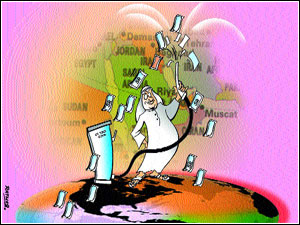 Some Arab countries appear to be incredibly rich. These include Saudi Arabia and the six Gulf states. Syria and Iraq have socialist regimes and state-controlled economies. Libya is also oil-rich, but state controls and sanctions are in the way of its economic growth. Egypt has problems of insufficient resources, population explosion, bureaucratic obstructionism and corruption. Morocco, Tunis, Jordan and Sudan are also short on resources.
Israeli anti-Arab policies threaten and adversely affect the economies of all the Arab states. But in spite of sitting on an ocean of black gold i.e oil, and in spite of excellent human resources and strategic locations, Arab economies remain stalled and raw material-based. The economies of the oil rich Gulf states, Saudi Arabia, Libya and Iraq are nurtured by sale of oil to Japan, the USA, Africa, Asia, Australia and the West. Fluctuations in the price of oil, manipulated by the West have adversely impacted their economies. International price of oil is controlled by the industrialized West and not by the oil-producing countries.
In a recent five-day symposium on the subject of “Future Vision for the Saudi economy”, organized jointly by the Saudi Ministry of Planning and the World Bank, speakers called for measures to stimulate the kingdom’s economy by diversification, private sector participation, human resource development and full use of information technology to speed up the stalled economic progress. Besides Crown Prince Abdullah, Deputy Prime Minister and Defence Minister, Prince Sultan, the Malaysian Prime Minister, Mahatir Mohammad with a large delegation of Malaysian experts participated in the symposium.
The Saudi government has decided to embark on an economic reform programme as part of it’s move to join the World Trade Organization. The plan is to throw open the Saudi economy to free trade, and encourage national and over seas investments. Saudi economic policies aim to reduce dependence on oil only. Prince Abdullah in his address said that the kingdom was now in the second year of its seventh plan. The five-year plans had been a major factor in stabilizing oil prices.
But the Finance and National Economy Minister, Ibrahim Al-Assaf, warned that dependence on oil revenues had made the Saudi economy vulnerable to fluctuations in the international oil market, and this had been a major challenge for fiscal policy planners in the Kingdom. The domestic economy thus was dependent on external factors on which the state had no control. Public revenues and government spending were not related to the domestic economic activity, but depended on oil earnings and domestic loans.
As a result, the budget has experienced continuous deficits, because revenues have failed to match expenditure.. Accumulation of staggering public debt of $168 billion has created immense pressure on the state treasury and the economy.
Current year’s budget deficit is expected to be about $12 billion. Revenues for the year 2002 are projected at SR157 billion ($41.9 billion) and expenditure at SR202 billion ($ 53.9 billion). Healthy economic development is not possible even for Saudi Arabia in the current adverse fiscal situation of dependence on oil earnings and heavy domestic borrowing.
Khaled Al Maeena, the brilliant economic analyst argues that lack of planning has stifled Arab economic growth. The problem is not merely the lack of revenue.
It is the absence of modern banks, modern banking system, and world class financial institutions, which could attract Saudi cash that is presently abroad. It needs to be recovered and injected into our faltering daylight economies.
The big question is, what has happened to the overall Arab economy? Why has it failed to keep up with the rest of the world?
The answer is that except for raw material, i.e oil, there is not much in the Arab world that the industrialized world or even the developing world wants. The Arab world, and for that matter the Islamic world, missed the industrial revolution.
It missed the information technology boom. The Arab and the Islamic world is completely sidelined and marginalized in anything related to science, technology, engineering, medicine and communications. Arab countries do manufacture second-rate textiles, building materials, or food stuffs for part of their domestic use.
Arab products are inferior even to Asian and Latin American products. Arab consumers prefer foreign goods, which have been made available in plenty in Saudi Arabia and in the Gulf countries. This policy has stunted industrial enterprise and domestic manufacture growth.
Entrepreneurs prefer commerce and real estate to unprofitable industry. The few Arab industries that are competitive, cannot find markets, the capital to implement their ideas and to grow or expand.
At the root of the problem is absence of serious planning, efficient banking, and half-hearted privatization schemes. And most important and devastating is the inability of the educational systems to produce thinkers and innovators.
There is more than adequate stress on religious education, but hardly any for science, technology, medicine and engineering.
The Arab world, especially the oil rich countries need institutions which could transform their huge capital into scientific creativity, to enable the Arab youth to blaze new trials and discoveries.
9/11 is a big setback for the Arab and the Islamic world, because the West in general and the United States in particular seem to be closing their doors to students from Arab-Islamic countries on one pretext or another.
The Arab and the Islamic world should see the writing on the wall, and try to stand on its own feet.
The Arab and the Islamic world missed the internet technology boom that generated billions of dollars, says Khalid Al- Maeena. Singapore has internet trade in excess of $38 billion. Bangalore in India has emerged as a capital of information technology.
Bangalore now rivals the Silicon Valley in California- USA. Recently the countries of Eastern Europe have restructured their economies based on information technologies and efficient financial and banking services.
A new investment strategy based on soft ware development has started revitalizing the economy of Ireland. The spirit of free thought and unfettered capital produces brilliant people like Bill Gates in the US, Richard Branson in the UK and Azim Premji in India.
The IT boom made thousands of millionaires overnight. And 70 per cent of them are under 30 years of age. The Arab and Muslim youth have missed the great IT boom and have been left in the cold, because of tardy policies of Arab-Islamic countries.
The dreams and ambitions of Arab-Islamic youth will remain shackled by archaic laws, tardy procedures, inefficient and obstructive bureaucracies, and unsympathetic governments. To go ahead and to revitalize economies, all this must be scrapped and the new generation given a fighting chance.






























