0
0

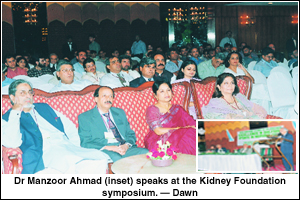 KARACHI, Oct 18: Speakers at the inauguration ceremony of a symposium urged the government to promulgate the cadaver transplantation law.
This was stated at the fifth symposium of the Kidney Foundation, titled “Excellence in dialysis — update in nephrology”, which got under way at a hotel on Friday night.
Delivering the Amir Tejani Memorial lecture, the Director of the Sindh Institute of Urology and Transplantation, Dr Adibul Hasan Rizvi, said that in the transplant operations carried out by his institute, mothers were donors in 47 per cent of the cases, while fathers had donated their organs in 25 per cent of cases.
“In foreign countries, organs come from cadavers in 48 per cent of cases. If we had a cadaver transplant law, no child would be left without a transplant operation,” he explained.
Speaking on the subject of “Current status of paediatric transplantation in Pakistan”, Dr Rizvi said the reason why it was so important to carry out transplant operations of children was that otherwise, their growth was impaired, they developed bone diseases, their quality of life was adversely affected and paediatric dialysis also had a bad psychological impact on children.”
He added that the patient compliance ratio was fairly high at the SIUT because the institute provided free treatment and drugs to patients, and had regular follow-ups by dedicated teams.
The chairman of the Usman Institute of Information Technology, Dr Manzoor Ahmad, said that in Pakistan, medical care was provided to individuals either on the basis of a contract between physician and patient, or as a matter of religious charity, or as a public welfare benefit, but it cannot be claimed as a human right. “There exists a strong moral, philosophical and religious argument justifying the right to medical treatment. I wish our lawmakers pay heed to it and evolve a rational health policy for meeting a range of needs and for dealing with many of the most debilitating and traumatic problems in our society.”
He said that “the over-consumption of medical drugs is not a characteristic of poor countries where qualified doctors are either scarce or are totally unmindful of over-prescription. The control of multinational pharmaceutical firms over the market is unique. Drug prices are controlled and manipulated. The same drug, selling at a place where it faces competition at a much lower price, sells at an exorbitant price in an underdeveloped country.”
In his welcome address, the Vice-Chairman of the Kidney Foundation, A. Razzak Tabba, said that Pakistani doctors abroad should come to this symposium every year and update the knowledge of our young doctors.
The Chief Executive of the Kidney Foundation, Prof S.A. Jaffar Naqvi, said that due to increased awareness, the attendance in tertiary care centres had decreased. He added that the medical institutions must be looked after by professionals.
The President of the Pakistan Society of Nephrology, Prof Sameeh J. Khan, said that the public sector alone could not bear the public cost, as resources were limited and were consumed by other requirements.
Earlier, Dr Rizvi shed more light on the details of transplants at his institute, adds APP.
The “SIUT has performed around 100 paediatric transplantations till date, with graft survival rate coming to 90 per cent”, he said.