0
0

NEW YORK, Oct 15: Pakistan on Monday severely criticized the UN Security Council for failing to intervene to resolve conflict in South Asia underscoring “there could be no clearer and more tangible threat to international peace and security.”
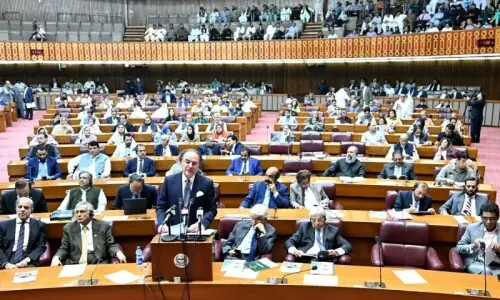
Addressing the UN General Assembly on the report of the Security Council and the “Question of equitable representation and increase in the membership of the Security Council and related matters,” Pakistan’s Ambassador, Munir Akram, said that “the Council cannot afford to sit idle; the world cannot afford to substitute conflict management for conflict resolution.”
“The UN Charter requires that in the event of breach of the peace, or a threat of use of force, the Security Council must address the situation with a view to restoring international peace and security.”
However, he observed that the Security Council has failed to act despite the fact its attention was drawn to the gravity of the situation on the Indian/Pakistan borders. “War may have been temporarily averted by the active diplomacy of some major powers. Yet, the two armies remain forward deployed. A war could happen by design or miscalculation.”
He lamented that “among the most glaring of the Council’s failures has been its inability even to discuss the India-Pakistan issue and the underlying dispute over Jammu and Kashmir, in spite of the fact that this item remains on the Council’s agenda.”
He pointed out “using the lexicon of the war on terrorism, India has deployed one million troops along Pakistan’s eastern border and the Line of Control in Kashmir. The Indian Prime Minister has threatened a decisive battle; the Indian Army Chief has asserted that, after a war, Pakistan would not survive in any “recognizable” form.”
“Artillery and small arms exchanges are a daily feature on the Line of Control. India has refused mutual withdrawal of troops; it has refused de-escalation; it has refused dialogue; it has refused third party mediation; it has refused the UN Secretary-General’s good offices. There could be no clearer and more tangible threat to international peace and security, even one were to discount the danger arising from the fact that the two antagonists are nuclear weapons states,” he elaborated.
In reference to the crisis in the Middle East he said the Middle East crisis, and the prolonged tragedy of the Palestinian people, had continued to challenge the credibility of the Security Council. The Council had achieved a high point when it adopted resolution 1397, creating the framework for a just, lasting and comprehensive solution of the Arab-Israeli conflict.
“Since then, however, confronted by repeated Israeli military incursions, punitive measures, the economic strangulation of the Palestinian people and spiralling violence in the occupied territories, the Security Council’s deliberations have become almost a parody of the role which the Charter had perceived for it as the repository of the political, moral and military authority of the United Nations in preserving and restoring international peace and security,” he noted.