0
0

One of the major worries of President General Pervez Musharraf and his team is that the new elected government may not like to continue the existing economic policies and reverse them after some time.
The international financial institutions (IFIs) have been expressing concern— both officially and privately— that the reform agenda of the government should continue failing which it would be difficult for them to extend financial support to Pakistan. Not only the IFIs, important bilateral donors including the United States, European Union and Japan expect the President to ensure the continuity of economic policies. They have said recently that present economic team should remain there even after the new government is formed— both at the centre and in the provinces.
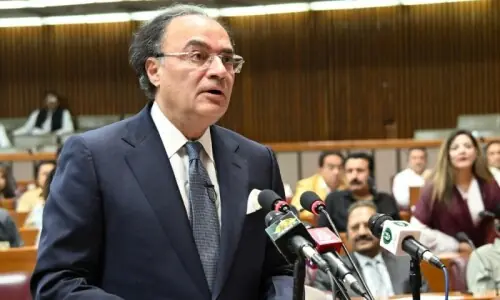
The message was reportedly given more clearly to the Minister for Finance Shaukat Aziz when he visited Washington recently and met the authorities of the World Bank, the IMF, and held bilateral meetings with the US Secretary of Treasury and the State department officials.
It is said that the finance minister called on the President immediately after his visit to the United Sates and informed him about the IFIs and other bilateral donors’ point of view regarding the continuation of the economic policies.
The President has already said that he was not against any further improvement in the economic reform programme by the future government. However, he has made it clear that nobody would be allowed to reverse or undo these reforms.
Pakistan is said to have been told to protect at any cost the reform agenda by ensuring consistency in policies. The Musharraf government has given assurances to the IFIs and other bilateral donors that he would personally make sure to protect his economic policies.
There were indications that the President might like to retain some of his key cabinet colleagues including Shaukat Aziz and the Minister for Science and Technology, Dr. Prof. Ataur Rehman. About Rehman, officials say that since he has been nominated chairman of the Higher Education Commission for three years with the status of the federal minister, he would automatically be retained and he would be given the same portfolio. Both are expected to be taken in the new Senate.
Insiders maintain that the new government would like to differ with the present government as far as banking reforms and privatization process is concerned. The present government has been extending golden handshake to banks’ employees and was still encouraging them to leave. However, the new government, it is said, would not take the risk of directly or indirectly inciting banks’ employees to leave their jobs. Similarly, the large scale privatization which has been planned would also not be acceptable to the new government.
The Privatisation Commission was encouraging the closure of loss-making public sector enterprises or seeking their early privatization. However, the new government, it is said, would not go for that option as it would create resentment among the people.
The World Bank and the IMF were supporting Pakistan because President Musharraf had taken some bold and unpopular economic decisions. He removed almost all kinds of subsidies and tried to manage fiscal deficit. Also his government introduced various measures to improve the functioning of the Central Board of Revenue by removing many of their employees. The question now is whether the new government would follow the same path.
It is said that one of the major reasons that brought criticism from the masses against the government was its decision to link oil prices with the international prices due to which there has been about 76 per cent to 120 per cent increase in various petroleum products during the last three years. This decision has attracted lot of criticism but since this is a commitment with the IMF, the new government will be in a fix to decide about this issue. Also there has been about 100 per cent increase in gas prices during the last three years and the IMF would want this trend to continue. But the question is whether the new government would afford to continue implementing what are termed as harsh and tough conditionalities of the IMF.
Interestingly, major political parties including PPP, PML(N) and PML(Q) and Mutihidda Majlis-i-Amal had been criticising the IMF policies for Pakistan during their election campaign. Now how would they deal with the issue if they come in power, is a very important question.
There had been criticism on IMF for forcing the present government to remove all kinds of subsidies for agriculture. The subsidy on fertiliser had already been removed. But still the government is giving some subsidy on a couple of agriculture inputs which otherwise are to be removed as per the conditionalities of the IMF.
It is said that the new government will have to face many challenges to deal with the donor agencies. How far the president could assert is difficult to say, although at times he sounds very authoritative about his reforms agenda.