0
0

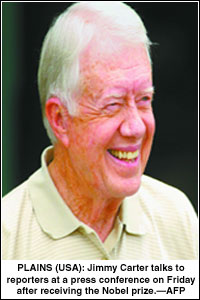 OSLO, Oct 11: Former US president Jimmy Carter was awarded the Nobel Peace Prize on Friday by a committee whose head called the decision a deliberate slap in the face for the current US government over its policy on Iraq.
Carter, a Democrat who was president from 1977 to 1981, was awarded the one million dollars prize from a record field of 156 candidates for decades of work to resolve conflicts from the Middle East to North Korea, and from Haiti to Eritrea.
“This honour serves as an inspiration not only to us but also to suffering people around the world and I accept it on their behalf,” Carter said in a statement released by his non-profit Carter Center in Atlanta.
The secretive five-member prize committee praised Carter, 78, for “decades of untiring effort to find peaceful solutions to international conflicts, to advance democracy and human rights, and to promote economic and social development”.
The prize, named after Swedish philanthropist Alfred Nobel, was widely hailed abroad as honouring an elder statesman who has been praised more since leaving office than when president.
“It’s great. He deserves it,” said U.N. Secretary-General Kofi Annan, who shared the 2001 Nobel Peace Prize with the United Nations.
The committee praised Carter for an “outstanding commitment” to human rights and for everything from his battle against tropical diseases to his help for developing nations. The prize will be handed over on Dec 10 in Oslo.
Carter came close to winning the award in 1978 when Israeli prime minister Menachem Begin and Egyptian president Anwar Sadat shared the prize for the peace accord that he brokered.
The committee that year wanted to give Carter the prize but he had not been formally nominated by the February deadline.
INCENSING GOVERNMENTS: Committee decisions have often antagonized governments.
The 1975 prize awarded to human rights campaigner Andrei Sakharov incensed the Soviet Union. The 1935 prize to German journalist Carl von Ossietzky prompted Hitler to ban Germans from ever accepting Nobel Prizes.
Carter won from a field that included Afghan President Hamid Karzai, Chinese dissidents and US disarmament experts in a year dominated by the aftermath of the September 11 attacks on the United States.—Reuters