



 0
0

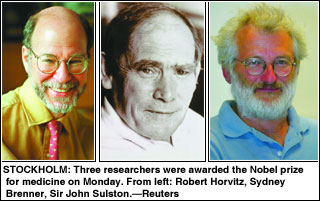 STOCKHOLM, Oct 7: Two British researchers and an American colleague were on Monday awarded the Nobel Prize for Medicine for gene research that opened up a new front in some of the worst scourges of health.
Britons Sydney Brenner and John Sulston, and H. Robert Horvitz of the United States, laid bare the mechanism by which genes regulate the programmed death of cells, a process vital to understanding cancer and other accumulative disorders, the Karolinska Institute of Sweden said.
Sulston said he was “surprised and obviously delighted” by the prize.
The Nobel jury said in its citation the discoveries were “important for medical research and have shed new light on the pathogenesis of many diseases.”
“Knowledge of programmed cell death has helped us to understand the mechanisms by which some viruses or bacteria invade our cells.
“We also know that in AIDS, neurogenerative diseases, stroke and myocardial infarction, cells are lost as a result of excessive cell death.
“Other diseases, like autoimmune conditions and cancer are characterised by a reduction in cell death, leading to the survival of cells normally destined to die.”
Much of the knowledge was derived from the genetic code of the nematode, a tiny earthworm that, thanks to Brenner, has become one of the most-studied animals in the world.
In the early 1960s, Brenner, who on his website says he likes “travelling, stirring up the scientific world and good wine,” selected the Caenorhabditis Elegans as a model for study because it is small, multicelled and plentiful.
Brenner, 75, is now at the Molecular Sciences Institute in California.
His research group, which at the time was at Cambridge University in England, was joined in 1969 by Sulston, who was studying how the worm grows from a single egg to the complex cells of an adult animal, and then moved on to map its chromosomes. It was one of the first lab animals to have its genetic code unravelled.
Sulston, 60, will also go down in history as one of the leading figures in the race to decipher the human genome, which culminated in a dead-heat last year between a public-sector consortium and a US biotech giant, Celera Genomics.
He demanded that genomic data be placed in the public domain, to be a spur for research, rather than be a copyrighted asset of private corporations.—AFP



























