0
0

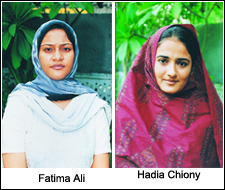 KARACHI, Sept 3: The students of private colleges, including five girls, dominated the merit list of intermediate part-II (class XII) commerce group annual examinations 2002.
The Board of Intermediate Education, Karachi, on Tuesday announced the results of HSC commerce annual examinations for regular students, with a pass percentage of 43.67, which is 2.28 per cent higher than that of the last year. Results of four private institutions remained 100 per cent.
According to the BIE statistics, 12,967 candidates were registered, out of whom 12,768 appeared in the exams, while 5,576, including 2,315 girls, were declared pass. The first six position holders managed to get marks higher than what the position holders of the last year had achieved.
Last year, the first position holder had obtained 863 marks out of 1100, while this year the highest marks were noted at 916.
The pass percentage of girl candidates from 45 educational institutions was 68.07, while in the case of boys appearing from 66 institutions it remained 34.81. However, the pass percentage of girl students remained 6.04 per cent lower than the last year.
A student of the DHA Degree College for Women, Fatima Ali Hussain, roll No 205790, clinched the first position in the consolidated merit list of boys and girls by securing 83.27 per cent marks. Another three students of the same college managed to secure 4th, 5th and 6th positions respectively.
Second position was bagged by Hadia Chinoy, roll No 206021, of the Commecs Institute of Business Education, who secured 83.09 per cent marks, while Tariq Meher, roll No 202972, of the Aga Khan Higher Secondary School got third position by securing 82.45 per cent marks.
In all, 9,367 boys had appeared in exams, out of whom 3,261 were declared pass. On the other hand, 3401 girls took the exams, out of whom 2,315 were declared pass.
Results of 97 candidates allegedly found using unfair means were withheld and would be released after any final decision by the board of governors, said a BIE notification. Seven of the 111 educational institutions failed to produce any results.
The breakdown of candidates who passed the examinations is as follows:
Boys: A-1 grade 2; A 128; B 594; C 1187; D 1154; and E 196.
Girls: A-1 grade 7; A 275; B 768; C 979; D 280, and E 6.
The position holders from four to six were: Sana Ahmed, roll No 205916 (81.73% marks), Humera Arif, roll No 205806 (81.36%) and Mahreen Fatima, roll No 205859 (80.91%).
At a ceremony arranged to introduce the position holders to the press, BIE chairman Prof Mohammad Sharif Memon, controller of examinations Prof Amjad Ali Syed, principal of the DHA Degree College for Women, Dr Tayyaba Mamoon and representatives of the Commecs Institute and the Aga Khan Higher Secondary School, Prof Shahina Mahmood and Adnan Mubeen, highlighted the issues and measures related to education.
The position holders were of the view that efforts should be made to ensure that intermediate class examinations were an assessment of conceptual studies and not mere the test of capability to produce the maximum on paper in a three-hour time, mainly based on rote learning. They called for making comprehensive computer education a part of commerce education.
In response to questions at the Karachi Press Club, Fatima Ali Hussain said girls were now taking more interest in commerce education only because their parents, who believed that it was now viable for their female wards as well, were allowing them to take it up.
She said geography course was entirely a lengthy one, while teaching in accounting also needed some modifications in line with today’s market requirements. Students alone could not excel in education or examinations unless they are not supervised and given special attention by their teachers, she said, adding that teachers at private colleges were more efficient.
Hadia Chinoy said she preferred to read foreign books or other than that of the textbook board’s publications. She suggested that students should develop their own way of study and prepare notes from different books to get more and more information on any topic.
The two position holders also did not like to have extra education at coaching centres as they believed that taking education at colleges and coaching centres simultaneously sometimes created confusion in the conceptual studies.
Referring to better performance by students of private institutions, the principal of DHA Degree College for Women said it was only that students were provided with an environment conducive to their studies and personal grooming.
The interaction among students, parents and teachers, she added, played an important role in raising the standard of education at private institutions. She said pay structure and other facilities also counted at private institutions.
Shahina Mahmood of the Commecs Institute said effective teaching was a complete team work. Adnan Mubeen of the Aga Khan School said students at his schools were motivated for a conceptual study.
BIE chairman Prof Memon said the pass percentage of about 20 colleges had improved this year. He pointed out that intake of brighter and meritorious students at any particular college also played a basic role in regard to better results.
He suggested that efforts should be made to improve the standard of education and other facilities to students and teachers at the existing government colleges instead of increasing the number of colleges.
“I understand that the capacity at colleges are more than enough to accommodate the entire number of students having passed the matriculation examinations and it will be appropriate if we could have improved the quality of academic environment by extending more support and guidance to students and financial and professional assistance to teachers,” he added.