



 0
0

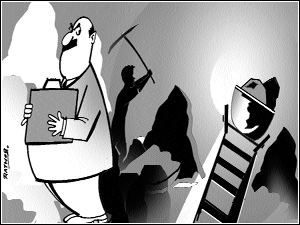 The mineral sector has the potential of cutting import bills of the country as well as to boost exports. The government seems to be quite aware of the potential of the mineral sector and the President has announced the mineral policy in June.
Past governments tried to develop the mineral sector but paid no attention to the problems faced by the private entrepreneurs in the sector. Instead, the past governments fell into the hands of corrupt, inept and lethargic public sector mining organizations. In this exercise the state exchequer suffered huge losses of public funds, but the mineral sector remained economically dead and repelling to the private sector. The recently announced national mineral policy has rightly forbidden the public sector organizations to involve themselves in mining activities, and restricted them to mineral explorations and studies for the express purpose of attracting the private sector to the mineral industry.
After the passage of one year the Federal Government still seems to be grappling with the task of pragmatic implementation of the mineral policy by the provinces . The mineral sector faces obstacles most of which are the products of over-regulation and non-developmental characteristics of the mining concessions rules and practices emanating from the colonial era in the country.
Our country is endowed with a variety of minerals of great commercial potential.It is true that promising geology alone of a country or good administration do not attract investment. The unfavourable and inconsistent policies increasingly deter investment in the mineral sector, like in any other sector. Over-regulation, uncertainty about rights in mineral titles and land use, high levels of taxation not only keep the new investors away from the sector but are even likely to shut down the existing mineral industries. In many countries, the functionaries of state administrations remain almost unaccountable for the impact of their actions under misinterpretations of the settled policies, which can discourage or even eliminate new investment in any sector. The functionaries of state often do so either deliberately to serve certain vested interests or just out of their whims.
To transform the dead mineral sector of our country into a live and vibrant one, the obstacles need to be removed. Some of the major hurdles faced by the mineral industry and proposals for addressing these problems are put forth here.
The menace of unsettled ownership of mining areas is the major threat to the development of the sector. The provincial administrations grant mineral titles to the mining firms and charge handsome rents for the areas, and royalties on the extracted minerals. But parallel to the ownership of the provincial administrations of the mining areas there exists a very strong, illegal and undocumented system of ownership by communities, bradaries, and influential heavy weights of the areas concerned. Through this system, the influential and heavy weights, in and around the particular mining area grossly interfere in the management of the mines. Seemingly, an innocent demand for providing jobs to their unskilled men is the starting point for pressurizing mine owners for extortion. Then follow the intimidation tactic by these elements aimed at forcing the legitimate mine owner to offer a partnership share to them without any investment by them or simply to settle for payment of a ‘bhatta’ (called royalty by these elements).
In the Balochistan province the problem is more complex .The provincial mineral licensing authority , before considering any application for the license for minerals areas, asks investor/applicant to provide a no-objection certificate to be obtained from the administration of the dist./tehsil concerned. The local administration of that particular tehsil then asks the applicant/investor to offer a partnership of up to 40 per cent with someone who is a permanent resident of the area. The province has acute dearth of capital and investors.
Normally, there exist no real investors in that locality and the investor, in most cases, has to abandon the idea of investing and getting a license for mineral areas. In desperate cases, the investor has to make partner a permanent resident of that area. Such forced partners do not actually invest in that business and the applicant/investors have to pay for the share of investment of such partners who are usually influential in the area.
Because of the condition of providing the no-objection certificate, even an investor from one district of the province is not free to invest and obtain titles in any other district of the province. It is also a fact, that neither the national mineral policy nor the constitution of the country allows such curbs on investment in the mineral sector.
The menace of unsettled ownership of mineral areas has kept the doors closed for any local or foreign investors in the mining sector.
One way to address this problem could be for the CBR to extend its tax net to the spurious, or otherwise, claimants of the ownership of the mineral areas, or the government should declare such areas as state property in explicit and practical terms.
The non-existence of infrastructure in the areas is another great deterrent to private investment in the mineral sector. The mining areas are mostly situated in remote deserts or mountainous areas. A private investor of small to medium category can not arrange the entire infrastructure from his own resources. In fact there is an immediate need of starting a countrywide programme of mine to market roads, on the lines of the current programme of farm to market roads. The wireless telephone facility similar to PCO should be provided at every mine. Because of the remoteness of the mining areas a higher level of security arrangements are needed for mining projects. The law-enforcing agencies should be directed to provide reliable security to the mining ventures.
The non-availability of financing to investors in the mineral sector is also a big hurdle. The Balochistan province has the highest mineral potential among the provinces and of course deserves more focus on its development. Unfortunately, the financial institutions at Quetta have no line of credit for financing mineral projects in the private sector.
It would be more appropriate if the government, instead of losing tens of billions of rupees through financing its loss making public sector mining projects , provides a comparatively much smaller amount as soft term credit line for providing financing to small and medium sized mineral projects in private mineral sector.
On the tariff side , a drastic change of mind on the part of the government is needed. Being a highly risky investment, the mining sector cannot absorb the current high level of taxation . For example, the highly advanced mineral sector-based economies like that of Australia, allow fuel to mining companies at about half the normal price. Tax regimes comparable to those adopted by the countries having the mining sector as a major player in their national economies, should be adopted by the government.
Duty-free import of mining machinery should be made convenient. The existing SRO 27 involves several windows like the Board of Investment, the Engineering Development Board. CCI, CBR, etc. which takes several months of running about by the importer, to finally get approved the zero-rated import of the required mining machinery. In the process, the resulting demurrages considerably erode the benefit of the SRO to the mine owner.






























