



 0
0

 The social security scheme in its rudimentary form for industrial and other workers was introduced for the first time in the year 1965 when the West Pakistan Social Security Institution Ordinance was made part of the statute book.
The social security institutions, PESSI (Punjab Employees Social Security Institution, SESSI (Sindh Employees Social Security Institution), ESSIs in NWFP and Balochistan were reorganized as such on the revival of the four provinces in 1970.
The source of income of these institutions is the collection of 7 per cent of the wages of workers earning up to Rs3000 per month—recently revised upto Rs5000 per month. Thus a maximum amount of Rs210 to Rs350 is payable by the employer in respect of such employees working in the registered industrial / commercial concerns established in the notified area under the social security law.
The main emphasis of the social security law was on providing health coverage or medicare of the workers including their families. It is estimated that about 0.8 million secured workers or about 5 million persons which include their dependents are being provided medicare through the auspices of the social security institutions in all the provinces. Besides, the general medicare, scope of which has increased in the recent past to the level of affording heart surgery for the secured worker, some cash benefits are also available to workers covered under the social security and these are as under:
i. sickness benefits; ii. injury benefits; iii. disablement pension; iv. maternity benefits; v. death grant (tajheez expenses), vi. iddat benefits.
It is estimated that the cumulative income and expenditure of all the four provincial ESSIs is in the range of Rs1.5 billion per annum. The per head expenditure, however, varies from province to province, and whereas it is around Rs2000 in Punjab, Rs2235 in Sindh, Rs3395 in Balochistan and Rs1760 in NWFP. It may be pointed out here that the cash benefits as enumerated above constitute a mere 20 per cent of the overall expenditure whereas the remaining 80 per cent is incurred on medicare.
A critical analysis of the scheme would reveal that it mainly catered for the health cover of the secured workers including other minor benefits. In fact, the social security law was never devised to meet the all comprehensive concept of social security as envisaged under the ILO conventions, for it was manifestly deficient in so far as it did not provide for any kind of financial assistance after the retirement of the employee or if he gets incapacitated due to any reason, how would he or his family survive.
It was in this perspective and the commitment made with the people of Pakistan in the Constitution of 1973 article 38(c) which reads, ‘the state shall provide for all persons employed in the service of Pakistan or otherwise, social security by compulsory social insurance or other means’ that the Employees Old-age Benefits Institution (EOBI) Act was passed in the year 1976.
As against the already existing the Social Security Law, EOBI was conceived to be a federal law with such kind of organization having headquarters’s at Karachi. Under the EOBI law, following four benefits were extended to the insured workers:
i) old-age pension; ii) invalidity pension; iii) widow’s/survivors’ pension; iv) old-age grant.
The EOBI funds are generated at the rate of 5 per cent of the wages of the employees of registered industrial or commercial organization having strength of at least 10 employees. This collection is made in respect of only such employees whose wages do not exceed Rs3000 per month, recently revised upto Rs5000. For the purpose of Old-age Pension (OAP), the age limit is fixed at 60 years for male workers and 55 for the female and the present minimum rate is Rs700 per month and maximum around Rs1500/1600.
At present, the EOBI has on its role the registered strength of 1.6 million employees of more than 46000 organisations throughout the country, and it has paid Rs107 million during March 2002 to its 202000 pensioners of all the four categories which include 52000 widows.
According to the EOBI sources, monthly collection is in the range of Rs140 million or Rs1680 million per annum. This shows that there is a net saving of about Rs30 million per month or Rs360 per annum. This kind of saving coupled with the matching grant which was received by the EOBI from the government till 1995 has provided a comfortable cushion for the activities of the EOBI so far and at present it has built up the cash reserves of more than Rs40 billion.
Of late, the federal as well as the provincial governments have been seized with the problem as to how to provide one window facilities to the employers as far the collection of levies under the Social Security and EOBI is concerned. This has not been possible so far for obvious reasons that the two charges are levied and collected under the separate laws viz ESSI 1965 and EOBI 1976 by the two separate organizations, one provincial and the other federal. Not only the rate to be charged is different, but the eligibility criteria in both cases are also different. For example the social security is charged at the rate of 5 per cent of the wages in case of an establishment in the notified area but irrespective of the number of employees, whereas EOBI is charged at the rate 7 per cent of employees’ wage in such organization where the number of employees is at least 10.
The general complaint by employers or the establishment owners has been the frequent visits by the officials of the EOBI or the ESSI on one pretext or the other. The law does not restrict the number of visits even. For example, any official of the EOBI under section 12 can check employers’ books for the purpose of verifying information relating to the number of insured workers, and for this purpose he may require the employer to produce and allow him to examine the accounts books and other documents or such other information as he may consider necessary. Such kind of vast discretionary powers of the inspecting officers have become the main irritants for the employers.
The issue being agitated by the employers is that only one authority should be entrusted to undertake inspections and to collect the charges whether under the ESSI or EOBI so that they are saved from the multiple visits by the different officials and officers. From the above discussion it should have been clear by now that it is possible only when both the laws are integrated. But if the laws remain separate and if any one officer is assigned to effect recoveries then there will be the problem of authority and responsibility as the officer of social security will not feel responsibility to achieve the target set under the EOBI or vice versa.
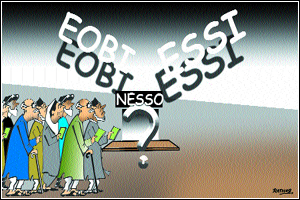
Accordingly the objective can be achieved only through the integration of these laws into a new one which may be nicknamed as, ‘national employees social security ordinance.’ (NESSO). The name NESSO is suggested with the background that essentially both the laws deal with social security measures, whereas under the present social security law more than seven cash benefits are extended, under the EOBI only four benefits are provided. The proposed law can further be fine tuned keeping in view the following premises:
(a) At first parameters of the coverage be made uniform in both the cases through adoption of the same definition of ‘employee’ ‘employer’ establishment etc. Then the existing provisions of the laws and how these are to be made uniform are to be spelled out.
(b) Let there be one and the same board of trustees (BOTs) / board of governors (BOGs) at the national level, which should b tripartite in nature, to be headed by the Federal Secretary labour. All the four provincial secretaries shall be the ex-officio members of this supreme body. (c) There will be provincial tripartite boards (PTBs) on the pattern of provincial workers welfare boards (PWWBs). All the activities under the NESSO in the provinces shall be monitored and supervised by these provincial boards.
(d) The BOTs/BOGs at national level shall be concerned only with the policy planning and allocation of funds whereas implementation and execution of the same should rest with the provincial tripartite boards.
(e) The employees of the provincial ESSIs as well as that of the EOBI shall be governed under the same law and the rules framed there under.
(f) Under the new law, social security officer shall be authorized to collect the lump sum Social Security charge at the rate of 12 per cent covering 7 per cent of the existing social security and 5 per cent of the EOBI.
(g) Under the integrated law, the in-charge officers shall issue new social security cards which shall entitle the employee to all kinds of social security benefits including medical coverage, cash benefits and old-age pension etc.
(h) The social security card holders shall be declared eligible to receive the marriage grants or death benefit or any other benefits being extended under the WWF by the provincial WWBs.
(i) The families of the employees concerned under the NESSO shall be entitled to receive benefits irrespective of their residence as in many cases families of the workers are not with them. This will, however, be possible only when the social security is introduced as such at national level and proper computerized national number is assigned to the employees.
(j) The EOBI was fortuitously conceived to be Federal in nature, whereas most of its labour related activities take place in the provinces, as such, its performance can better be monitored and evaluated at the provincial level by the PTBs.
(k) As to how to constitute PTBs under the proposed law, the easy solution would be to assign this duty to the existing provincial WWBs or to the provincial BOGs of ESSIs, so that there is a proper coordination and monitoring of the welfare activities at provincial level. Indeed this will provide single powerful platform for all kind of welfare activities for the labourers. Even separate tripartite boards can be constituted for the purpose.
(l) As regards the number of visits and discretionary inspections, this can be replaced with self-assessment under the new law. Further, at present assessment is made at the rate of 5 per cent of the wages of the employee and for this record of the employer is to be checked. Flat rate contribution can be adopted as an alternative to the present system of assessment and collection, which is bound to minimize the contact of officials with the employer.
(m) In fact, the integrated law is envisaged on the pattern of WWF Ordinance 1971 which enshrines the spirit of tripartism at the federal as well as at the provincial level. It further entails decentralization and devolution of the EOBI activities at the provincial level along with the social security measures and making both of them available under the one roof. This will be in line with the present policy direction being pursued by the federal government whereby it intends to devolve some of its functions at the provincial level.






























