0
0

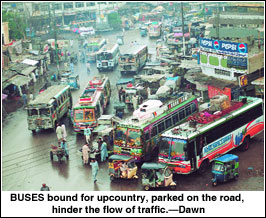 KARACHI, Aug 8: A survey of Lea Market shows that transporters regularly flout all traffic rules and the police have failed to take any notice of it.
All types of vehicles from the city routes and the upcountry arrive or depart here and the whole area has been virtually converted into a huge bus terminus where the transport mafia reigns supreme.
A complete chaos is witnessed during the peak hours of morning and evening when the upcountry transporters park their vehicles in the middle of roads, blocking the traffic in complete violation of rules.
The area people allege the police take no action because they act in collusion with the transport mafia which has become so powerful that it now controls all the routes in the surroundings of the market where they park their vehicles without fearing any authority. Admitting that they have failed to shift the transport business from residential areas, the municipal authorities have accused the police of non-cooperative attitude in this regard.
According to the survey, Lea Market has turned into one of the biggest terminuses in the city where a number of local inter-city and inter-province buses, mini-buses either terminate or start their journey. Besides, a number of local buses, mini-buses make their intermediate stops here or pass through the market. The situation has turned the area into one of the most congested in the city.
As the number of buses is rapidly increasing, the space for parking is becoming more and more insufficient. All the open spaces previously used for parking purposes now have buildings on them, leaving bus-operators with no choice for parking but the roadside.
Local buses and mini-buses terminating their journey here ply from Landhi, Malir, Quaidabad, Gadap and Korangi. All these buses are parked on the roadside which is one of the main reasons of traffic congestions in the area.
The buses for inter-city routes arrive here mainly from the interior of Sindh, ie, Thatta, Sujawal, Banu, Sewan etc. There is a small open plot available for parking these buses. Buses here also arrive from or depart for various cities of Balochistan and the NWFP, including Hub, Lasbela, Khuzdar, Turbat, Quetta, Gwadur and Peshawar. During the past decade the number of these buses increased manifold as a large number of workers come here for their journey to Hub and Bela.
These buses park at Sheedi Village Road and Chawkiwara Road and now are gradually encroaching upon the old tonga stand.
GOODS TRANSPORT: Almost every building around Lea Market has a warehouse or some storage facility on its ground floor. A large number of goods trucks enter the area for loading or unloading goods. The activity goes on all the day or even at night. These trucks are not only causing traffic congestion but are one of the major sources of air and noise pollution. The residents have demanded that the movement of these trucks be banned during daytime or the warehouses be shifted outside the city.
Moreover, there is a wholesale milk market in Lea Market. The pickup trucks which bring milk from various parks on the main roundabout of the Lea Market block the traffic for several hours during the morning, afternoon and evening.
Encroachers have occupied every inch of the market land either by force or by greasing palms of the local police. According to the area people, the encroachment business is worth millions of rupees. Restaurant owners and shopkeepers are paid for parking of upcountry buses in front of their restaurants and shops.
Lea Market was developed by the British as a local market. Until the 1960s the market and its surrounding areas remained pleasant shopping spots for middle and low-income groups. They used to come here not only from various parts of the city but also from the interior of Sindh and Balochistan as it had a variety of utilities ranging from vegetables and fruits to cloths and jewels.
But soon after the construction boom started in the 1970s, the area was hit by a population explosion and the situation has been worsening since then. Construction contractors changed the face of the entire area without any planning. The destruction was accomplished by transporters and encroachers.