



 0
0

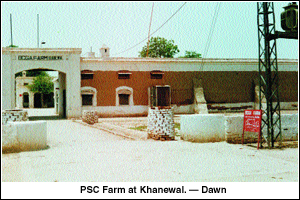 MULTAN, June 17: The government is preparing to crush the tenants’ revolt with a final showdown at the Peerowal farms of the Punjab Seed Corporation in Khanewal district.
The tenants and their families — more than 20,000 people — have been associated with the 7,174 acres land in Chaks 86, 75, 87, 83, 85, 82 and 81 (10-Rs) for almost a century. Today they are chanting two slogans — Ownership or death and Those who cultivate should have the right to reap.
This year they did not share the wheat crop yield with the PSC. The corporation has lodged cases against 426 tenants alleging theft, embezzlement and illegal removal of the produce. The tenants have all been granted interim bail by Multan bench of the Lahore High Court.
The tenants in all seven villages have now sown cotton on their own. The PSC authorities have reportedly requested the Punjab government to take stern action, pleading that the revolt is a threat to its very existence.
On June 9, a heavy police contingent, including Elite Force men, had raided the farms to crush the revolt. The tenants and their families put up stiff resistance and the police were forced to fire at the crowd and use teargas. Several villagers were injured in the incident. One Haroon Masih sustained a bullet injury. The police, later, cordoned off the Peerowal farms and would not let anybody leave the area. Villagers claimed that two people died that day after the police refused to let them be taken to hospital.
Anticipating more attacks, the tenants have dug ditches around the villages. The residents, including women and children, take turns to guard it round the clock.
The government is reported to be planning launch a major offensive. A source in the Khanewal administration told Dawn it had been decided at the highest level to destroy the cotton crop sown by the tenants.
During the early 20th century the land was not very productive. Some tenant families used to cultivate the well-irrigated land. The construction of the Lower Bari Doab Canal, however, changed things. The British government then leased the farm land in the seven Chaks among the director (Agriculture) and the principal of the Lyalpur Agriculture College.
Since farming was still not mechanized, the tenants already working on the land were hired to cultivate the vast tract. Qualification for tenancy was ownership of a pair of oxen and a team of two healthy men. Every year, the oxen and the men had to appear before the leasing agency (the British Cotton Growers Association) staff to verify their physical condition. The tenancy accounts were also settled on the occasion. The deed between the government and the agency was initially 20 years. It could be extended for two more similar terms subject to the parties’ consent. Lease money was Re1 per acre per annum.
The lease allowed the lessee to set up Robert Cotton Association, the first ginning factory in this part of the subcontinent in mid-1920s. The RCA also started marketing American cotton seed in the area produced at the BCGA farms at Peerowal.
The tenants who have survived from the days told Dawn their situation was no better than slaves. They said a huge bell hanging in each of the villages was rung whenever Mr Robert visited. At the sound of the bell the tenants had standing orders to step out of their houses, leaving whatever they happened to be doing. irrespective of whatever they were doing when the bell would ring. In 1940, the lease was extended for another term of 20 years.
The BCGA had to surrender most of the land in 1959 after the promulgation of land reforms. The tenants applied for the ownership but their request was turned down. Instead, the land was handed over to the Agriculture Department which in 1961. Later it was transferred to the then West Pakistan Agricultural Development Corporation.
In 1976, the National Assembly passed the seed bill and the Punjab government promulgated the Seed Corporation. The World Bank provided three seed processing plants for the corporation — one each is working at Peerowal, Rahim Yar Khan and Sahiwal. A senior PSC official told Dawn that the World Bank authorities had apprehensions about the tenants’ role in the project and insisted on a formal agreement between the Corporation and the tenants.
Over the years the Punjab Seed Corporation and its officials have prospered but the socio-economic condition of the cultivators have not been improved. “We are living in the same slavery as under the gora (white man’s) Raj,” 100-year-old Darshan Masih of Chak 86 said. “For us, the year 1947 made no difference.”
Majority of the Peerowal tenants are living below the poverty line. Their relations with the PSC became sour with the improving fortunes of the PSC officials and diminishing incomes of the tenants.




























