



 0
0

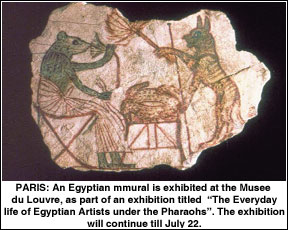 PARIS: Guillemette Andreu-Lanoe is a 53-year old commissioner at the Musee du Louvre, and with her rather unusual exhibition on “The Artists of the Pharaoh, Deir-el-Medineh and the Valley of the Kings” whose short title is “The Everyday life of Egyptian Artists under the Pharaohs” - she’s making a name for herself, indeed for the museum whose reputation has long hung on stodgy exhibitions done in rather dusty digs.
The exhibition, which already is attracting a standing-room-only crowd and promises to be one of the more popular in recent Louvre history - opened on April 19 and will close on July 22 - that is, if it is not extended by popular demand - and is housed in one of the museum’s largest exposition rooms, the Hall Napoleon, appropriately named for the man who perhaps did more than anybody else to make France one of the founding forces of Egyptology.
Andreu-Lanoe says that it’s not for anything that her approach to Egyptology - and to this exhibition in particular, the first time the Louvre has consecrated a major exposition to the subject of Egyptology, usually reserved to the Musee Guimet - has often been labelled as frivolous. And, she agrees, that if she is considered frivolous, it’s not for anything that the word is affixed to her and to her exhibition, says Mrs Andreu-Lanoe. “One of my professors, the noted Egyptologist Georges Posener, told me one day that above all I should remain frivolous. I listened to him and today I think I’m still a “midinette”, a frivolous schoolgirl at heart.”
One of the country’s best-known Egyptologists, Andreu-Lanoe lost no time in gathering together some 350 pieces, all from Deir-el-Medineh, the village, located between the Valley of the Kings and the Valley of the Queens, where lived 3000 years ago the “men of the tomb,” the artisans responsible for building the tombs of the Pharaohs.
Such exhibits, notes Anne-Marie Romero, French daily Le Figaro’s cultural correspondent, “usually limit themselves to Gods, tombs, and Kings.” This one, she reports, “speaks to us in a simple fashion of one of the largest archaeological sites of ancient Egypt, a miracle of sorts, and of the way men, women and children lived and worked there during 450 years.”
And the people in question who are at the centre of the exhibition are not your ordinary everyday man-in-the-street, rather the architects, sculptors, painters, scribes, indeed the quarry-men who carved out the blocks of stone from the earth, who devoted their lives to constructing the monuments where eventually they would repose, supposedly forever, in peace.
One of the tombs that was not completed, that of Horemheb, in the Valley of the Kings, is at the centre of the Louvre exhibition and provides a startling look into how the artists and artisans in question went about preparing and constructing the monuments with which today Egypt is largely associated.
The exhibit presents the stages of the work of the decorators, indeed is able to present the sketches - in red ink corrected in black - where we see before our eyes a tomb take shape. One of the more curious examples - and such things are symptomatic of Andreu-Lanoe’s approach - has a sketch of a procession of Egyptian women where one of the architects, obviously troubled by the rotund nature of their forms, has redrawn them to make them as slim and slender as if they were everyday women of today overly concerned with appearing to have a curve or a pound too many.
The exhibition is done in conjunction with the Egyptian Tourism Ministry whom will certainly benefit royally from such an exposition that will undoubtedly work another miracle and return to Egypt the tourists who have feared - because of attacks by political extremists - to venture there in recent years.



























