0
0

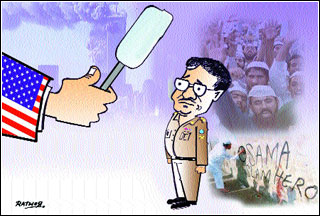 SINCE Pakistan jumped into the global coalition against terrorism, our financial spin-doctors have been making upbeat estimates and have been trying to convince the nation as if the US was going to give us the moon in return for what we were offering.
The hopes are evaporating now. With every passing day it is becoming more and more evident that putting Pakistan economy back on track through foreign assistance was no more than a mere pipe dream at best. Seven months after gaining the ‘front line’ status, Pakistan’s economy has failed to get out of woods.
Though there have been some positive developments at the external front, overall economic scenario remains as gloomy as it was before the September 11. This article attempts to briefly analyse gains and losses of Pakistan’s economy in the wake of America’s war against terrorism and Pakistan’s decision to join the US-led international coalition.
Direct cash grants for us have amounted to around $ 800 million, including an impressive US grant of $ 600 million. Oil import bill has gone down substantially and remittances by expatriates have risen significantly, to around $ 900 million. In addition we have been able to secure some more loans from IFIs, including Poverty Reduction and Growth Facility (PRGF) by the IMF. As a result, the treasury is now ‘overflowing’ with $ 5.5 billion of forex reserves, a record in the monetary history of country. This is just one side of the coin. Have we been able to reap enough rewards? The answer is very short and simple, No.
Pakistan was able to get an impressive re-profiling of its entire bilateral debt, amounting to over $ 12 billion in December for a long duration of 38 years and with 16 years as grace period. No doubt it was a huge breathing space. But have the creditor countries generous enough towards Pakistan in getting it out of debt quagmire it is caught in? Following statistics give us a true picture. Pakistan owes a massive $ 38 billion to the developed world, the IFIs and commercial banks, and the people of Pakistan have only one thing on the mind: complete debt write-off. A number of experts and analysts are quoting the example of Egypt which saw half of its $ 7 billion debt written-off during the Gulf war.similarly some Far East Asian countries that decided to ally with the United States after second world war were given complete debt write-off by the later. Moreover,those countries were also provided technical assistance from the US at initial stages of their reforms.
What Pakistan was able to secure at the end of President General Perevez Musharraf’s high profile visit to the United States of America, in February this year, fell woefully short of the expectations. While the debt relief announced was much less than what our financial managers were hoping for, more evasive was the manner in which it had been spelled out. Finance Minister Shaukat Aziz says that the US will write off $ 1 billion out of a total $ 3 billion owed by Pakistan to it before the next budget.
Even if the net amount of the waiver is $ 1 billion, it is no more than peanut as compared to the “services” Pakistan has rendered in the America’s fight against terrorism.
And that too is subject to certain condition. The chairman of the International Relations Committee of the Senate has said it clearly that Pakistan would have to ensure elimination of extremism, de-escalation of tension on the eastern borders with India and restoration of democracy. What can Pakistan do more than it is already doing by way of de-escalation with regard to the ongoing tension with India? It also shows that the announced assistance would not be flowing smoothly and the US would keep Pakistan under continuous pressure for the release of funds.
Similarly, high expectations were attached with General Pervez Musharraf’s visit to Japan that took place in mid-March. To say the least, he returned empty handed. There was no talk of debt reduction.Though Japan had lifted sanctions, imposed on Pakistan earlier, in November last year, it has not restored $ 500 million Official Development Assistance which we were receiving before the nuclear tests. Moreover, Japan has linked any investment to betterment of law and order situation and continuity in economic policies.
No doubt that net present value of our debt has gone down by 3 to 4 billion dollars with these measures, but the real burden has not decreased.
The other disappointment is regarding the enhancement of market access for Pakistan. Neither the US nor Japan came to our rescue as for as external trade is concerned. Federal Minister for Trade Razzaq Daud has expressed his dismay over this.He says that Pakistan was expecting an increase of up to $ 400 million in the textile quota by the United States, but the announced measure would fetch no more than $ 142 million. The gap between expectations and the ground reality is quite evident. While Japan showed willingness to import fruits and vegetables from Pakistan, world’s second largest economy was reluctant to give greater access to our important export items.
Later, the Committee for Implementation of Textile Agreement (CITA) issued a circular on March 17 confirming a 15 per cent increase in quota for a few categories of cotton and man-made fibre textile products, produced or manufactured in Pakistan with effect from March12, 2002 until December 31, 2002. Experts as well as exporters believe that all the categories for which quota has been increased, are underutilized and would not translate in to any meaningful advantage for Pakistan.
It is important to note here that Pakistan is already expecting a shortfall of about $ 1.5 - 2 billion in its exports over the previous year in the wake of post- September 11 events. The announcement throws cold water on the hopes of textile manufactures that were waiting for the revival of industry through a better deal by US.
The European Union, however, was more generous than both the US and Japan in this regard. Not only they have increased the quota of Pakistani exports but also reduced the tariffs significantly. Pakistan is expected to reap a benefit of around $ 400 million through this package by the European Union.
The benefits of the President’s visit to the US and japan are coming but in meagre amounts and at a very slow pace. Given its outright support for US-led coalition against terrorism, Pakistan should have received a more preferential treatment from the international community, the United States in particular, to put its weak economy on right track.