



 0
0

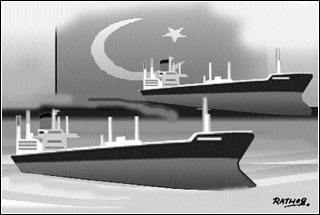 THE efforts made by the present government for economic revival is commendable. Its policies are generally welcomed and highly appreciated by investors. The government should also be complemented for the “Pakistan Merchant Marine Policy-2001” which is a great step forward for the shipping industry.
Although the shipping policy was announced in July 2001, the CBR SROs were not in line with the shipping policy for import duty and sales tax on vessels and also for tonnage tax in lieu of income tax, etc. However, with the effort of the ministry of communications and the ministry of finance the SROs of the CBR are in the process of being corrected.
Shipping industry was nationalized in 1972 and since then there has been a serious decline. Our fleet of oceangoing vessels which was over 78 has now come down to 11 vessels. The Pakistan National Shipping Corporation (PNSC) has in the meantime also lost about Rs 3 billion. Over 50 ships were scrapped without any replacement. As the number of our own ships was considerably reduced, the training programme of officers and engineers met with serious set-back. The number of approved marine workshops was reduced considerably. The prospects for employment of our officers were also considerably reduced. We did not have skilled manpower to compete with our neighbours and more recently from China, the Philippines and Ukraine. These countries have developed a highly skilled programme of training, and the remittances from the seafarers alone serving on foreign vessels, to each of the above countries is in the region of about $2 billion. We have the requisite manpower but not the facilities, planning or the will power to train our personnel to meet the competition. The demand is still there but we seriously lack marketing. The earlier bureaucratic formalities did not help.
The shipping policy meets most of the requirements for which we have been inspiring except that a preferential treatment has been given to the PNSC in the order of priority of cargo preferences, as if the past over 30 years’ record of the PNSC was not known. This greatly discourages the private sector as equal rights are being denied.
We also understand that while the shipping policy was in the process of being finalized, the PNSC took the opportunity of making a presentation before the cabinet committee on ports and shipping to convince them that they should be given the exclusive right for the transportation of about 7.5/8 million tons of crude oil which is being imported in the country, and happens to be the only secured FOB cargo, and as such their eagerness to secure same. This effort has been to negate the sharing by the private sector as per new shipping policy. The private sector had no knowledge about this presentation. The cabinet committee approved the presentation of the PNSC and the refineries were asked to enter into a ten-year contract with the PNSC for the transportation of the crude oil. This move by the PNSC may give temporary relief to their organization, but would jeopardize the much awaited Pakistan merchant marine policy 2001, eliminate healthy competition, and would be detrimental for the Industry.
Under the existing arrangement for the last several years the PNSC is arranging transportation of crude oil at World Scale 200 which amounts to about US $6.8 per ton. The lifting is mostly by foreign flag chartered vessels at the market rate of World Scale 165 to 85 (currently 85 which works out to about US $3.20 per ton). This differential freight rate benefit for a quantity of 7.5 million tons has greatly helped the PNSC to earn at the cost of refineries and tax payers, to offset their losses of dry cargo vessels which they are continuously incurring. So the current improvement in the PNSC accounts is due to their charging high freight on transportation of crude oil, and other cosmetic savings, if any, are marginal. This is all on record. This is also reflected in the published annual and bye annual statements of Accounts of the PNSC. This cannot last for ever as privatization of refineries is on the card, and the management as also the concerned ministry will be accountable for such excessive payments, which shall eventually come to light.
Due to manipulation of petroleum product suppliers to use their own tankers, it has not been possible for the PNSC from its very inception to lift any portion of the petroleum products which is about 12 million tons. Petroleum products are equally or more strategic, as compared to crude. Under the circumstance it would not be practical to expect new comers to transport any portion of petroleum products in the early stages, as it would require time to break the well-knit old hegemony.
The PNSC had a share in the Conference Line and also in the consortium for the transportation of cargo under container traffic. This movement is in the region of about 6 million tons, but they could not maintain their position.
The bilateral agreement with India also hampers the participation of the Pak Flag Panamaxes or Handymaxes for the regional cargo, as out of ten cargo originating from Europe and America about 70 per cent is destined for the Indian sub-continent, and the PAK Flag vessels have to obtain No Objection from the Indian Government. As such cargo is lost to other competitors in the meantime. From the above it can be seen that the PNSC is only keen to secure the assured FOB cargo of 7.5/8 million tons of crude oil, and has made no dedicated efforts for about 12 million tons of equally strategic petroleum products, or 6 millions tons traffic by container vessels or other dry cargo by Panamaxes or Handy maxes.
We have no doubt that our government would encourage the private sector who would be re-entering the shipping industry after a lapse of about 30 years, and give equal treatment in cargo preferences to build up the shipping industry as investors intend to equalise marginal utility of investment alternatives. Investment can be mobilised by ensuring equal opportunity to the private sector, and we pray that the same would be forthcoming. This is also in line with the requirement of the IMF and the World Bank.
If we can mobilise the private sector by giving it equal opportunity, the addition of ships will have a multiplier effect on the national economy, as about 63 per cent of the gross revenue is retained within the national economy. Each additional vessel will provide direct employment of 45-50 persons, provide a viable base to repair yards, ship chandlers, spare parts, fuel and other vendors and peripheral services.
Training establishments for marine personnel are built around the backbone of a productive national fleet. The national fleet can spawn a host of peripheral services in financial, insurance and legal sectors. Maritime administration can meaningfully interact at international forums only when we have a national fleet.
Without a tangible national fleet Pakistan could have poor credibility and clout at international maritime and trade forums.
The government must recognise the role of the shipping industry in our economy, and continue to create conducive investment environment to raise capital resources, and assure equal treatment to the private sector in cargo preferences with the PNSC. The government and private units in the shipping industry must work in partnership, to compete with global competitors.
I conclude by stating that our policy and decision-makers should, seriously, consider the installing of an Imodco-Buoy off the Karachi harbour coast for our crude oil import; the pipelines from the buoy, on the sea-bed, must lead into oil + storage tanks on the shore. The writer succeeded in having an Imodco Buoy moored — installed, off the entrance to the port of Chittagong as long ago as 1963.






























