



 0
0

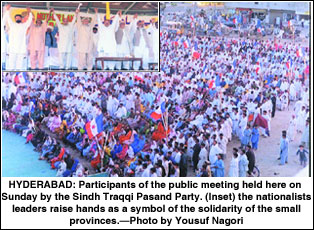 HYDERABAD, April 21: A public meeting, held here on Sunday by the Sindh Taraqqi Passand Party to mark its founding day, has demanded that the Chashma-Jehlum and Taunsa-Panjnad canals should be closed and Sindh should be given its due share of water.
Another resolution, rejecting the Kalabagh dam, pointed out that the dam had been rejected by the Sindh Assembly on three occasions, the NWFP Assembly on two occasions and the Balochistan Assembly on one occasion.
It further said that although the oppressed nations — Sindhis, Seraikis, Baloch and Pakhtoons — had repeatedly rejected the Kalabagh dam, Gen Pervez Musharraf had again announced the dam’s construction.
In another resolution, it was pointed out that the natural and mineral resources of Sindh, valued at billions of rupees, and the income generated by the Karachi harbour amounting to Rs450 billion were being usurped by Islamabad for the last 50 years, due to which unemployment in Sindh had spread like an epidemic.
The meeting demanded that the right of Sindh over its own resources should be acknowledged and hundred per cent employment in the industrial units and other sectors should be given to the local people.
The meeting, in another resolution, termed the greater Thal canal project a death warrant for Sindh and lashed out at the Wapda for initiating the project which would destroy the Sindhi and Seraiki people. It was of the opinion that the Thal canal was aimed at benefiting Punjab.
The meeting was of the opinion that the military regime had hatched a conspiracy to hold the country hostage by abolishing parliamentary system of government and demolishing the democratic norms and the right to differ by appointing a security council and a uniformed president. The resolution said that the oppressed nations were being left at the mercy of Punjab and the presidential referendum was aimed at enslaving the oppressed nations.
The meeting termed the referendum unconstitutional, violation of human rights and democratic norms, and a direct attack on the historical rights of the nations.
Rejecting the presidential referendum, the meeting demanded elections for a new constituent assembly to ensure equal rights to all the nations.
The meeting observed that Sindh was passing through the worst crisis since the creation of Pakistan and its history, language, culture and economy had been destroyed and its financial resources had been usurped by Punjab.
It alleged that the federal government had ceased to be the representative of Pakistan as it had become the protector of the interests of Punjab.
It demanded equal rights for all the nations.
The meeting held Punjab and the federal government responsible for the deteriorating law and order situation in Sindh and alleged that the secret agencies and the state had encouraged dacoits, ethnic terrorists, and religious terrorists.
It further said that state violence had increased due to the permanent deployment of Rangers and paramilitary forces and it had also put Sindh under tremendous financial pressure.
The meeting demanded equal representation of the oppressed nations in the armed forces and other federal organizations and stressed that the posting of Punjabi bureaucrats in Sindh should be stopped forthwith.
The meeting further demanded that the outsiders, including Afghan refugees, should be sent back to their own countries.
It slammed the inclusion of army officials in the courts and demanded that the interference of the executive in the judiciary should be stopped.
It demanded that the standard of education, which had been intentionally destroyed, should be improved.
It condemned the atrocities unleashed by Jews against the Palestinians, and demanded that Ariel Sharon should be tried in the International Court of Justice for the genocide of the Palestinians.
It further demanded that an international force should be sent to stop Israeli terrorism, and an independent sovereign state of Palestine should be established.


























