0
0

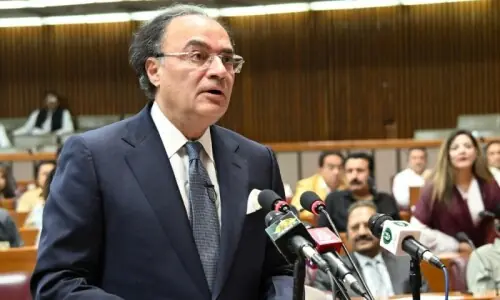
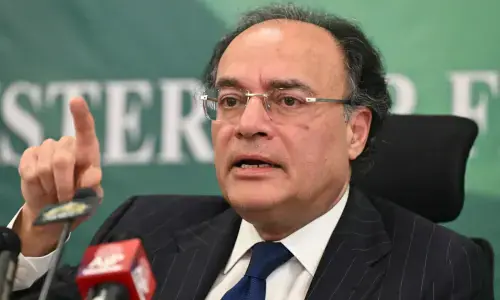
ISLAMABAD, April 8: Finance Minister Shaukat Aziz on Monday said that economic growth could effectively reduce poverty, provided it was accompanied by a comprehensive programme for social development.
“Human capital is the primary asset of the poor and its development is of fundamental importance in the war against poverty,” he added.
Speaking at the inaugural session of 3rd meeting of the finance and planning ministers of Saarc here, he said that every person in the region must have access to basic education, primary health care and other essential services.
However, he pointed out that the quality of governance is critical to the poverty reduction. “Good governance facilitates participatory, pro-poor policies as well as sound macroeconomic management. It ensures the transparent use of public funds, encourage growth of the private sector, promote effective delivery of public services, and help establish the rule of law,” the finance minister said.
Economic cooperation in the fold of regionalism, he pointed out, was taking place in many parts of the world but South Asia has remained deprived of the fruits of regional cooperation.
In a rapidly changing global trading environment, the current state of inter-Saarc trade was highly disappointing, he added.
“If South Asia does not make special efforts to strengthen its economic ties, it is feared that this region will completely be sidelined in the world trading system and the poor in this region will remain deprived of even the basic minimum,” he warned.
He was of the view that fighting widespread poverty by the low-income countries of the South Asian region alone would be a daunting task. “But together with strong support from our development partners, the battle against poverty and human deprivation can be won,” he added.
“While we welcome the significant progress achieved so far in implementing the enhanced Highly Indebted Poor Countries (HIPC) initiative, it is equally essential to evolve an effective mechanism to provide relief to highly indebted non-HIPC countries that are willing to use debt relief process to create the basis for sustained growth and poverty reduction,” the finance minister said.
Mr Aziz said that lack of education, basic health facilities, safe drinking water, sanitation, shelter, justice, powerlessness, voicelessness, in addition to low levels of income was giving rise to the feelings of human deprivation, resulting in extreme behaviour which could threaten national, regional, and global peace and prosperity. “The challenge before us is, therefore, to fight human deprivation by taking a broad-based view of poverty,” he believed.
He said one-fifth or 1.2 billion people subsist on under one dollar a day and just under half, i.e. 555 million live in South Asia.
At the national level, the finance minister said that there must be a credible programme of poverty reduction. “The principles of our strategy must include the following: that it should be country driven, it should be based on participatory process so that it is owned by the people; it should be result-oriented and focussing outcomes that would benefit the poor; it should be partnership-oriented so that it can provide avenues for active and coordinated participation of our development partners; and finally it should be based on a medium- to long-term perspective, recognizing the fact that sustained poverty reduction can not be achieved overnight.”
He concluded his speech by saying that “let us forge a partnership for peace in the region. Let us make Saarc as a vehicle to achieve our common goal of fighting poverty by improving governance, macroeconomic management and sharing of ideals and approach on common issues which confront all of us.”