0
0

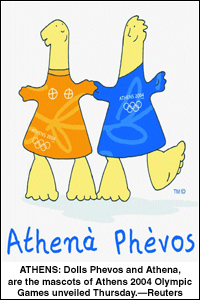 ATHENS, April 5: Two bell-shaped cartoons of children, inspired by an ancient Greek doll and named after two Olympian gods, were presented on Thursday as the mascots for the 2004 Athens Games.
Phevos and Athena, a brother and sister named after the god of light Apollo and his sister the protectress of the city of Athens, were revealed during a ceremony by chief Athens organiser Gianna Angelopoulos.
“The mascots are two children of today, a brother and sister. Their inspiration is ancient Greek,” she said.
“We wanted it to be modern, along the image of Athens 2004. We wanted it to be different. Most of all, we wanted it to have history and personality.”
The big-footed siblings, one dressed in blue and the other in orange, were chosen from hundreds of proposals as the most representative of the Athens Games — both ancient and modern.
The clay doll with dangling legs which inspired the mascots can be found in Greek museums and is the kind of toy ancient Greek athletes would have played with as children, organisers said.
Since the skier Schuss was introduced in 1968 at the Grenoble Winter Games, Olympic mascots have become lucrative publicity tools.
The popular sheepdog Cobi, created for the 1992 Barcelona Games, was the most profitable while Moscow’s Russian bear Misha, at the 1980 Olympics, was one of the most endearing.
Children replaced cute animals as mascots for the first time at Lillehammer in 1994.
Atlanta’s Izzy, the first computer-generated mascot, confused audiences on 1996 and Sydney came up with three animal mascots in 2000, an idea which helped reap more profits.
Angelopoulos said the International Olympic Committee (IOC) had shown “enthusiastic” approval for the Greek choice.
IOC’s chief inspector for Athens Denis Oswald said Greece was right to delve into its history for inspiration.
“I think the mascot symbolises the historical aspect,” he told reporters after the presentation. “I think the historical element should play an important role.”
Greece, the birthplace of the ancient Olympics, won the bid to host the 2004 Games by stressing its modern strengths alongside its rich cultural heritage.—Reuters