0
0

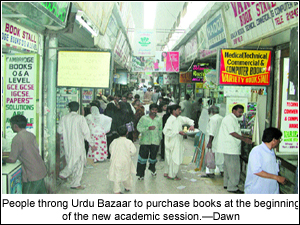 KARACHI, April 2: With the advent of the new school academic session (2002-2001), students and their parents are thronging bookshops, but to their dismay booksellers do not have to offer them the complete range of textbooks, because of failure by the Sindh Textbook Board to provide textbooks on time.
According to a survey carried out at urdu Bazaar, the worst hit are students of primary classes in government schools, who are excited about their promotion to higher classes, and with enthusiasm look forward to have new textbooks and to attend classes.
Parents and booksellers criticized the Sindh Textbook Board (STBB) for not coming up to the expectations of the students. Publishing and marketing books was not a new job or assignment popping up suddenly, but it was poor planning and lack of interest on the part of the authorities concerned that textbooks were not available on time, and experience being repeated year after year, students and parents said.
According to figures compiled by the Executive District Officer Education, Karachi, there are about 900,000 students enrolled at primary, lower secondary and secondary levels in government and private schools in the city, out of which about 40 per cent of the students belonged to primary classes.
Sources in the market said only about 40pc of the prescribed textbooks were available for onward distribution. In the case of primary school textbooks the situation was worse as there were only 25pc of the prescribed books available for new classes, teaching for which in government schools began on April 1.
Some of the STBB’s books, which were not available till Tuesday, included Mathematics for Classes I, II, III, IV, VII and VII, English for Classes I and V, Sindhi (for Urdu-speaking students) for Classes IV, V, VI, VII, Islamiat Classes V, VII, Pakistan Studies for Classes IX, and many others.
The situation vis-a vis English-medium or private schools is not very encouraging either. The STBB’s textbooks, which are compulsory study for them under the government policy, are unavailable.
However, parents of lower-and middle-income groups complained about uncontrolled marketing of English-medium books, by private publishers. For some of the books of foreign origin press they were overcharging. Local publishers were copying them and they had supplied sub-standard books at higher prices.
A senior educationist said prices of textbooks prescribed in many private schools, published in the private sector, could be reduced, provided the publishers curtailed their entertainment and recreation bills with regard to promotional campaigns. If the major publishers refrained from recovering the expenditures involved in the publication of fancy books on political and social subjects and biographies by overcharging the students for schoolbooks, then the prices of textbooks could be cut considerably, said the educationist.
For a primary class students of a private school you had to pay Rs650-Rs950 for a set of books alone, and in addition there were the expenditures on exercise books and other educational material, said a mother while coming out of a bookshop.
The government talked of compulsory primary education, but the ground realities were very discouraging, commented a man, claiming that a even the much-trumpeted scheme of “free distribution of books” for primary schools in rural areas appeared to be being practised on paper only.
Sources in the educational circle said the government paid and arranged for free distribution of books to primary school students in many area, but it never moved to ensure transparency in distribution or practical delivery of free books in many of the areas earmarked for the purpose.
One shopkeepers confided to this reporter that books prepared for free distribution were also available in the open market in the previous years. The city government, with financial support from the Sindh government, had planned to distribute textbooks worth Rs12.5 million this year, but who knew when these books would be available to students, commented the bookseller.
To review the failure of the STBB in supplying markets with textbooks throughout the province, a meeting of the Board was held on Monday presided over by its newly appointed chairman. Some of the publishers, who had been hired by the Board to publish books on behalf of it, complained that the situation had gone beyond their control as the STBB had failed to supply printing papers for the books on time.
“We were promised that we would get paper in January and February, but after much hue and cry the supply began only very recently,” said the proprietor of a major private publishing house, adding books would start coming out of press adequately within 20-25 days.
It was further learnt that the problem aggravated due to non-functioning of the STBB’s own presses. Following the closure of the STBB press, now the job had been assigned to a few private publishers on an emergency basis, but they were finding it difficult to cope with the situation as they did not have their own printing machines or publishing setup. So they were sub-letting the job, said a source in the market.