0
0

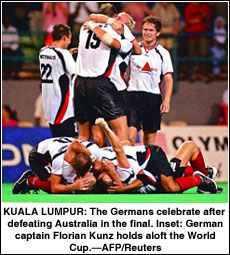 KUALA LUMPUR, March 9: Germany rounded off what has been a rewarding two weeks for them by capturing the World Cup Hockey crown Saturday for the first time, finishing off Australia 2-1 in a Kuala Lumpur classic.
A packed to capacity National Stadium saw Germany, who had not won the trophy in nine previous attempts, score the match-winner through their evergreen forward Oliver Domke in the 65th minute after both teams were level 1-1 at halftime.
Germany, the European champions, had to brush aside a strong challenge from Australia to score this memorable victory that left the Kookaburras ruing their fate over yet another near miss, having failed to get rid of the ‘chokers’ tag that has seen them fall at the penultimate hurdle three times in the past. They lost in the semifinals at Lahore in 1990, again in Sydney ‘94 and Utrecht four years later.
Germany, in only their second final since the World Cup began in 1971, fought back from a goal down with a 35th minute short corner strike from their captain Florian Kunz who neutralised Australia’s advantage they had gained only four minutes earlier when Troy Elder was bang on target off a well-executed penalty corner drill.
The Germans attacked through Domke, Christoph Bechmann and Sascha Reinelt with all of them coming close to scoring after being pinned down in the initial stages by the speedy Aussies.
Germany’s best chance to go 1-0 up came when Matthias Witthaus hit the post with 13 minutes to go for halftime while Domke and Bechmann also came dangerously close, only to be blocked by Lachlan Dreher in goal.
It was the first defeat of the tournament for the Aussies, who had gone into the decider after topping Pool ‘B’ with a maximum of 21 points from seven games and seemed unstoppable. Not even the Olympic and defending champions the Netherlands could put the brakes on them and were flogged 4-1 in the semifinal, so explosive was their form.
But it was not to be their day Saturday. Despite having taken the lead and putting on another good display they were stunned by the talented Domke, who scored in a crowded circle at a time when there was barely any time to stage a fight back.
Australia worked hard with Jeremy Hiskins, captain Paul Gaudoin and Bevan George creating problems for the German defence, which however stood strong. Germany had only two short corners in the match while Australia forced five.
The King of Malaysia, Sultan Azlan Shah presented the glittering World Cup to the German captain, who only last Wednesday was named Player of the Year.
German coach Bernard Peters could not hide his excitement and told a post-match news conference that his side deserved the victory. “Once Kunz scored the equalizer, I knew that we could do it.”
Meanwhile, the Netherlands defeated South Korea 2-1 through a Derk Jaap Buma golden goal to finish in third place and salvage some pride following their semifinal flogging by Australia.
For the South Koreans, the fourth place was their best World Cup finish in three attempts. Eighth in Sydney and seventh in Utrecht, they were in the lead by the 9th minute when Seung-Tae Song deflected in a shot from close range.
South Korea, the Olympic finalists, looked well on their way for a podium finish, but in a sudden change of fortunes, the Dutch forced the game into extra-time through an intelligent goal, deflected in by Sander van der Weide, with only a minute remaining.
Having got the equaliser, it became clear the Dutch would not now let the match slip away, and rightly so. With just three minutes gone into extra-time Buma nailed the Koreans and with it the Asian hopes of salvaging pride.
South Korea were the only remaining flag-bearers of Asia, after the fall earlier of Pakistan and India, the champion sides of the past, who finished fifth and 10th respectively in this tournament.
“It was not a scenario we wanted, you don’t want to play an additional minute in this tournament if you can avoid it,” Dutch coach Joost Bellart. “We needed to finish it quickly. Today I am very happy with the golden goal rule.”
The South Korean coach Jeon Jae-Hong said that the Europeans were still strong in all tournaments. “As Asians we must understand what our problems are.”
Final standings:
Champions: Germany; Runners-up: Australia; 3. Netherlands; 4. South Korea; 5. Pakistan; 6. Argentina; 7. England; 8. Malaysia; 9. New Zealand; 10. India; 11. Spain; 12. Japan; 13. South Africa; 14. Belgium; 15. Poland; 16. Cuba.
Leading scorers:
10 — Jorge Lombi (Argentina), Sohail Abbas (Pakistan).
7 — Dave Matthews (England).
6 — Takahiro Yamahori (Japan), Craig Victory (Australia), Greg Nicol (South Africa), Danny Hall (England), Justin King (South Africa), Song Seung-tae (South Korea).
5 — Mario Almada (Spain), Baljit Dhillon (India), Bjorn Michel (Germany), Kuhan Shanmuganathan (Malaysia), Troy Elder (Australia).
Fairplay Trophy: South Africa.
Best-Player-of-the-Tournament: Troy Elder (Australia).
Man-of-the-Match: Florian Kunz (Germany).
*Bronze medal match
South Korea 1 Netherlands 2
*Final
Germany 2 Australia 1