



 0
0

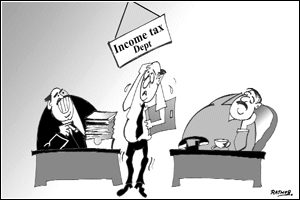 Contrary to the earlier speculations that the recommendations of the task force on tax administration (TFTA), headed by Syed Shahid Husain, formerly of the World Bank, have been rejected, it appears that the government has decided to implement them with marginal modifications.
The TFTA was appointed in June 2000. It furnished its report, formulated with the help of 11 members, 2 advisors, 9 institutional supporters, 6 contributors, 5 administrative supporters, 16 consultants, in late April 2001.
How much money was spent on its compilation is anybody’s guess, because this fact was never made public, giving rise to rumours of millions spent and those of favouritism. This piece proposes to discuss the part of the report which pertains to the income tax department.
After taking into account the overview of income tax revenue, tax base, tax compliance, etc., the report set about analyizing the key processes and organization in the income tax department.
The faults, lapses, malpractice,misconducts and corruption prevalent in the department were highlighted. It was pointed out that obtaining a National Tax Number (NTN) was a major chore, there was no standardized filing system, assessment process was long and cumbersome, the payments of tax were not properly recorded, taxpayers’ convenience was completely disregarded, etc.
To remedy this dismal state of affairs, the report proposed a separation of functions in the department, each division performing a distinct function, so that the benefits of specialization could be obtained. The functions of each division are briefly discussed as follows:
1. Taxpayer Assistance and Facilitation Division: The primary function of this division is to provide assistance to the taxpayer. It will be responsible for registration of new taxpayers and issuance of NTNs, receipt of returns, rectifying the mistakes, redressing complaints of delay, issuance of exemption certificates, etc. Additionally, it is also charged with responsibility of taxpayers’ education.
2. Information Processing Division: It would be responsible for data entry, processing, storage and access to all data bases. This computer based on-line network will have a number of capabilities, including identifying each taxpayer by his unique tax number, on-line accessing from any point, recording tax collection and keeping its track recording and keeping track of major transactions undertaken by the individual taxpayers et al.
3. Audit Division: It will be manned by persons with specialized training. They will be required to audit cases assigned individually to them, with the help of books of accounts and the information provided by the Information Processing Division. In the performance of their duty, the auditors may also visit the premises of the taxpayers. They will be relieved of the responsibility of managing a circle, collection of taxes, filing of appeal etc. The auditors will not be allocated a territorial jurisdiction. They will be assigned cases after selection for audit has been made. Thus interface between the auditors and the taxpayers will be reduced.
4. Enforcement Division: The primary function of this division would be to collect taxes. Additionally it would be responsible for initiating proceedings against non-filers allowing stay or grant of instalments against tax demand, levy of penalties, etc.
5. Legal and Prosecution Division: Its functions include handling of appeals both at the first and the second stages, filing of references to high court and appeals to Supreme Court. It will keep record of all legal decisions and provide assistance to the audit division on legal issues. It will also be responsible for prosecuting tax-evaders.
Apart from the 5 functional divisions, there will also be a Human Resources and Management Division, responsible for imparting appropriate training, career planning, performance evaluation, etc.
According to the report following preconditions are essential for the success of the scheme:
a) Universal self-assessment scheme
b) Audit to be done at the taxpayers’ premises
c) Each taxpayer’s profile is created in the data base which is automatically updated at each step.
d) A centralized record keeping is maintained and the information can be made available to whosoever requires it in real time.
The working of the scheme is based on computerization from beginning to end. It envisaged massage purchases of hardware and development of software for every function of the department.
The number of machines required and the nature of software to be developed has not been enunciated. And the most serious lacuma in the report is that it is completely mum about the cost of the scheme.
For argument’s sake, let us ignore the financial implications (by the way the news that the IMF has promised an aid or loan of US $ 200 million is completely unfounded.
The fact of the matter is that the authorities concerned have not even started calculating the cost of the proposed scheme) and try to evaluate the scheme from the point of view of its efficacy. Can it reform our taxation system and augment the tax collection?
There is no disputing the fact that the income tax department suffers from the ailments pointed out, that there is huge tax evasion in the country and something needs to be done urgently.
But not necessarily by adopting a system which is alien to our genius and is not workable in the conditions peculiar to our country. Let us examine this postulate.
There are two professed advantages of the scheme. Specialization through separation of functions and building up a faceless organization to combat corruption.
The idea of specialization through separation of functions of an assessing officer is not new. Shorn of the verbiage and the employment of computer technology, the scheme under review is similar to the one implemented on experimental basis in the late sixties and abandoned in the early seventies having been found unworkable.
Why? Because the functions of an assessing officer are inseparable. His most important function and greatest expertise is the ability to audit. The functions of collection of taxes once the assessment is made, filing of appeals, giving appeal effects, filing reports and administering a small unit consisting of 6 to 7 officials are insignificant as far as the time required in carrying them out in concerned.
The proposed scheme places heavy reliance on two assumptions; that it will work automatically in 100 percent of cases and that those involved in implementing it would have unquestionable integrity.
Both these assumptions are wrong. Try to visualize the plight of a taxpayer who is unfortunate enough to get caught in the web of the new scheme:
He now has as many bosses as there are divisions and will have to run from one office to the other, which would become doubly difficult because the offices are widely spread. In fact, in some cases, they may even be located in different towns. Although the system has been advocated as one-window operation, in practise it will turn out to be a complete antithesis of the concept.
The other side of the picture is no less bleak. Turf wars are sure to ensue between the officers of different divisions. Even if this factor is ignored the task of attaining coordination between the divisions will pose serious problems which may even become insurmountable.
And the biggest problem would be that no one officer can be held responsible when anything goes wrong because there will be a divided responsibility.
Let us now examine how much the proposition of facelessness can be effective and how much it can combat corruption. Firstly, it is obvious that one-to-one contact will not be completely eliminated. A taxpayer whose case is selected for audit has to come in contact with the concerned officer. That neither the officer nor the taxpayer was aware of each others identity prior to the selection of the case matters very little indeed.
The idea that this delayed contact will eradicate or even reduce corruption is based on incomprehension of the dynamics of corruption.
Corruption is essentially a two-way street and occurs with mutual consent of the parties involved. As long as evasion of tax exists, corruption from the tax departments can not be eliminated.
Reducing the chances and the frequency of the contact will have no effect on the reduction of corruption.
As has been noted earlier, the entire edifice of the scheme is based on computerization with an efficacious central information system and its proper management.
Proper training and reduction of load in the work were also recommended. If these recommendations are applied to the present set-up, the improvement in our tax collection is bound to be prodigious, and we do not have to adopt a half baked and alien system which has been tried in the past and has failed.
The biggest deficiency in the report of tax administration is that it has completely ignored the other side of the tax maladministration in this country i.e. deliberate and massive tax evasion universally practiced by the taxpayers and dully abetted by others.
Recently two banks went under (NDFC & Indus). Both were audited by prestigious firms of chartered accountants and no defects were pointed out in their affairs, at least not publicly.
It smacks of partiality that we have had a plethora of commissions and task forces for curing the ills of the tax departments but never an effort was made to combat the menace of tax evasion by the taxpayers. Unless we cease to hold the view that it is only the inefficiency and corruption of the tax collector which results in tax evasion, ignoring the part of the other players, the malignancy will continue to eat into the very vitals of our economy.






























