



 0
0

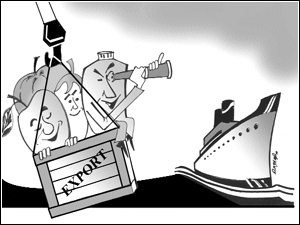 Despite positive results obtained through concerted efforts on the part of the Export Promotion Bureau (EPB) and exporters to boost exports during the year ending June 2001, the country now faces new challenges arising out of China’s entry into the World Trade Organization (WTO) and the expiry of the agreement on cotton and textiles (ACT) in 2005.
Moreover, the situation emanating from September 11 act of terrorism in the USA and the Afghan War needs a strategic approach not only for maintaining the present growth rate in exports but also to achieve long-term objectives of rectifying the country’s balance of payments position and reducing the external debt burden.
China’s entry into the WTO would entirely change the pattern of global trade. Pakistan having major reliance on exports of cotton and cotton textiles items may find China as a strong competitor and it is rightly apprehended that any further shock to this sector would upset the entire economy of Pakistan.
A likely threat stems from the moves of China and India which are major cotton-consuming countries to import cotton and cotton yarn from America and other cotton-exporting countries after finding Pakistani market less competitive.
The obvious fact that the ACT will expire in 2005 and trading in textiles will not be under constraint any longer, China now being in the WTO would explore the market for these products and Pakistan is likely to loose the market unless concerted efforts are undertaken to have closer economic relations with China.In this regard, apart from having bilateral trade agreements with China, contracts at lower level or in other words, through private sector should be entered with India, Russia and China (all these despite being cotton-producing countries have large cotton consumption for their indigenous industry), to retain thecountry’s market share.
Apart from protecting existing volume of exports of cotton and cotton yarn, the EPB must move to make greater alliance with China for exporting fashion garments as China has a large fashion garment industry, dominated mostly by foreigners.
Accordingly, Pakistan can have an indirect access to world-wide market of fashion garments through China which has emerged as a strong member of the WTO. Experts have predicted that China, in order to enhance its market share in export of cotton textile items, is likely to locate its textile industry in western provinces which are nearer to Pakistan through Karakuram Highway.
This necessitates Pakistan ‘s immediate move to have bilateral trade agreements with China as apart from importing cotton, cotton yarn and gray cloth from Pakistan involving minimum transport cost, China would like to have an access to Middle East and the European markets through Karakuram Highway.
Moreover, Pakistan can have better collaborations with China in the field of information technology which apart from being beneficial to Pakistan, would help China in removing language barriers which is necessary for diversification of its software exports.
Due to the cancellation of export orders after September 11, the country is faced with a gap of about US$ 2 billion to reach the target of $10 billion for the year ending 30th June 2002. In order to recoup the immediate loss thus arising and also to accelerate the rate of growth of exports, following diversified export destinations are suggested:
* Sincere efforts should be made to find a foothold in the Russian and the Central Asian markets which we have lost in the past.They now depend on China, Europe and Malaysia for imports. The African and the OIC countries also need to be tapped on priority basis.
*Major reliance on export of cotton and cotton textile items (being almost 60 per cent of the total exports) need to be reviewed. A major chunk of textile exports comprise of gray cloth and yarn. Efforts should be accelerated to produce value-added products.
Focus should be shifted to items like fruits, vegetables, plastic goods, electric items, sanitary goods, denim fabric garment, etc. Fresh and dry flower arrangements have vast potential export markets also. Engineering goods, especially, automobile spare parts have ample export potentials. During the last three years, export of auto-parts have risen from $10m to $25m.
The EPB has a very ambitious plan to raise the export volume of this item equal to $100 million at the earliest. Further, the market for electrical goods, especially of electric fans can be explored in the UK, Canada, Australia and the African countries. These facts, if taken care of, would not only boost our exports but also would give impetus to small and medium-size industries, which in turn, would generate substantial employment in the country.
For promoting small and medium-size industries producing value added exportable items their problems in respect of non-availability of institutional credit without collaterals and heavy taxation should be looked into on a priority basis.
It is hoped that the SMEs bank due to start operations from 1st January 2002 will have special focus on those entrepreneurs who are not in a position to offer tangible collateral for acquiring loan.
No doubt, right from the 70’s, the government has been providing cheaper credit to exporters, both for their pre-shipment and post-shipment needs, but for small exporters, non- availability of adequate collateral causes a problem. For that, the proposed export guarantee scheme should be floated at the earliest.
The major problem being faced by small exporters of textile items is the non-availability of quota. Since in order to compensate the loss accruing to Pakistan after September 11 and more troubles being in store as a front-line state, the European Union countries have enhanced the quota for Pakistan by 15 per cent and have abolished tariffs.
Similar announcements are expected the USA and Canada along with promises for providing greater access to their markets. In this regard, it is essential that for the distribution of additional quota made available, preference should be given to the new and small exporters.
The problem of liquidity faced by textile goods exporters also needs immediate attention. The cases of refund of sales tax and rebate should be settled at the earliest. It would be in the fitness of things that their demand for a separate ministry of textile is accepted.
For helping exporters to explore markets for their products, the EPB should set up product display centres in the regional capitals of central Asian States and the Middle Eastern countries.
In this regard, the EPB ‘s plan to set up export houses in the USA, Far East and the European countries in the near future will go a long way in introducing nontraditional items in these markets.






























