0
0

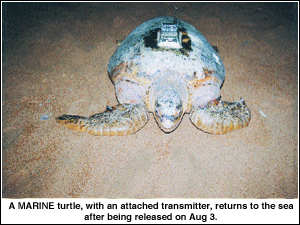 KARACHI, Dec 19: Two female marine turtles which were fitted with satellite transmitters that monitor their migration pattern have gone missing off the Karachi coast, it is learnt.
Sources said that though the scientific project, aimed at monitoring the entire yearly cycle of the turtle movement, had been supposed to last for nearly 12 months, it had run into snag as the turtles could not be located less than two months after the transmitters had been fitted on them.
The sources said that the project had been launched jointly by the World Wide Fund for Nature (WWF), the United Arab Emirates’ Environmental Research and Wildlife Development Agency (ERWDA) and the Sindh Wildlife Department (SWD) at the start of August.
The sandy beaches of Karachi, besides receiving usual beach- goers and merrymakers, also play host to some unusual guests — marine turtles — that regularly come here to lay their eggs during the nesting season.
The turtles that had come to lay eggs at the Sandspit beach on the nights of Aug 2 and Aug 3 respectively had been caught by scientists and satellite transmitters had been pasted on their shells. Later, they had been released at the same place on the beach so that they could return to the sea.
The transmitters attached to the turtles — named Chandini 1 and Chandini 2 respectively — started sending the data that was retrieved through the sophisticated satellite-based data system, ARGOS.
The data was being received at the laboratories of the ERWDA in the UAE and the WWF in Lahore simultaneously. Since the SWD does not have such receiving system, the WWF shared its information with the SWD.
Both the laboratories of the ERWDA and the WWF were receiving data regularly and monitoring the movement of both the turtles. According to the received data both the satellite transmitter mounted turtles were living in the vicinity of the Karachi beaches which confirmed the information that had been known from the wildlife research literature earlier that turtles lived through out their lives in the vicinity of the beaches where they were born.
Both the turtles, after laying the eggs on Aug 2 and Aug 3, again visited the same beach twice to lay eggs, maintaining an approximate gap of around two weeks between each visit. In their three clutches, both laid over 250 eggs each.
Though each of the female turtles laid such a high number of eggs in a year, all the marine turtle species are threatened with extinction and are declared endangered species around the globe.
The turtles during the first year of their life have a very high mortality rate — that is, only one out of every 1,000 eggs laid, grows to become a mature turtle. The rest are eaten up by various predators, thus Nature has made a system that keeps the equilibrium; otherwise oceans would have been filled up with the turtles.
The WWF deputy director-general, Dr Ejaz Ahmad, told this reporter that both “Chandanis” had been spotted throughout August and up to the middle of September as the satellites had sent their positions regularly showing that both of them had been residing in the vicinity.
“But for the last couple of months the satellites have not able to locate the turtles. A reason for that could be the movement and presence of the ships in the vicinity which may have disturbed the turtles. The number of ships has, sadly, gone up.”
He said that another reason could be the high magnetic field generated by sophisticated gadgets being used by these ships which might also be affecting the signals coming from the satellite.
Lina Kabbara, who was monitoring the turtle movement at her ERWDA laboratory in the UAE, has also not been getting any data relating to the presence of “Chandinis”. Writing to the WWF, she said that besides Chandinis she was not able to get good data regarding the location of a Hawkesbill turtle — another turtle species which she had been monitoring under another ERWDA project for the past few months.
Frederic Launay of ARGOS, responding to scientists’ queries, said that either the transmitter batteries had worn out or these turtles might have died.
The WWF, however, maintains that it is difficult to accept that the same thing could have happened to both of the turtles simultaneously.